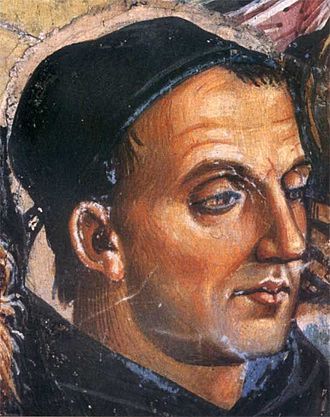
Fra Giovanni da Fiesole, known posthumously as Fra Angelico, was an Italian Dominican friar and painter active during the early Florentine Renaissance.
The Prado Annunciation is an altarpiece painted by the Italian Renaissance painter Giovanni da Fiesole, known as Fra Angelico, in the 1420s. It is one of his best-known works. Originally destined for the convent of the observant Dominicans of Fiesole, the painting is currently in the collection of the Museo del Prado in Madrid.
The work was painted for a side altar in the Convent of San Domenico, Fiesole, where Fra Angelico was a friar. For the same church he also contributed the main altarpiece, showing the Virgin and Child Enthroned with Dominican saints (c. 1425) and the Coronation of the Virgin, now in the Louvre (c. 1424 to 1435) . History →
The scenes have a structure similar to the other two Annunciations but with some differences. Description →
In the predella there are five scenes from Mary's life ( Birth and Marriage, the Visitation, the Adoration of the Magi, Presentation at the temple and the dormition) where the master had worked freely on the composition, less subjected to the iconographic tradition of the main scene. Predella →
The Adoration of the Magi is a tondo, or circular painting, of the Adoration of the Magi assumed to be that recorded in 1492 in the Palazzo Medici Riccardi in Florence as by Fra Angelico. It dates from the mid-15th century and is now in the National Gallery of Art in Washington, D.C. Most art historians think that Filippo Lippi painted more of the original work, and that it was added to some years after by other artists, as well as including work by assistants in the workshops of both the original masters.
The painting has been generally identified with one recorded in an inventory of the contents of the Medici Palace made in 1492 after the death of Lorenzo the Magnificent, by which time the painting was several decades old. History →
The painting shows the three Magi or "kings" presenting their gifts to the infant Jesus, who is held by his mother. Saint Joseph stands beside her, and the manger, ox and ass of the usual depiction of the Nativity are behind this main group. Description →
The painting as it now appears is believed to have developed in several stages. In the usual reconstruction, first advanced by Bernard Berenson, the painting was begun by Fra Angelico and his workshop, probably in the 1440s. Stages of painting →
The Annunciation of Cortona is a panel-painting altarpiece or retable by the Italian Renaissance painter Fra Angelico: once housed in the Church of Gesù of Cortona, it is now held at the Museo Diocesano in Cortona.
The Annunciation of Cortona was painted by Fra Angelico in 1433 to 1434, in tempera on panel, 175 cm x 180 cm. This is one of three Annunciations by Fra Angelico on panel (the other two are in the Prado Museum, and the Museo della Basilica di Santa Maria delle Grazie, in San Giovanni Valdarno. History →
This work is the main panel of a polyptych work, which includes a multi predella panels with scenes from the Life of the Virgin at the same Annunciazione di San Giovanni Valdarno: Marriage of the Virgin, Adoration of the Magi, Presentation in the Temple, Dormition. They are also attributed to Zanobi Strozzi, an assistant of Fra Angelico. Description →
The scene is typical of Christian iconography, "The Annunciation to Mary by the Archangel Gabriel", is described in the Gospels and in great detail in The Golden Legend of Jacobus de Voragine, the reference book of painters of the Renaissance, which can be represented in all its symbolic (walled garden column, the presence of the Holy Spirit, an evocation of Adam and Eve expelled from Paradise). Theme →
Madonna and Child is a c. 1435 fresco fragment by the Italian Renaissance master Fra Angelico in the sacra conversazione style. It was originally painted in the dormitory of the Convent of San Domenico, Fiesole. It was removed from the wall after the convent's suppression during the Napoleonic occupation of Italy and is now in the Hermitage Museum in St Petersburg.
The Last Judgment is a painting by the Renaissance artist Fra Angelico. It was commissioned by the Camaldolese Order for the newly elected abbot, the humanist scholar Ambrogio Traversari. It is variously dated to c. 1425, 1425 to 1430 and 1431.
Like most of Fra Angelico's work, the iconography is standard for the contemporary treatments of the Last Judgement. Among the most common subjects of painting in churches, it is found more often on walls. Description →
The Madonna of Humility is a tempera-on-wood painting by Fra Angelico, executed in 1433 to 1435, which belongs to the Thyssen-Bornemisza Museum in Madrid and is conserved on loan at the National Art Museum of Catalonia.
The Virgin seated on a cushion placed directly on the ground with the child standing on her lap, holds a vase in her left hand which contains roses and a lily, symbols of motherhood and purity. The Child, who is also holding a lily, rests his forehead on his mother's cheek. Description →
The Coronation of the Virgin is a painting of the Coronation of the Virgin by the Italian early Renaissance painter Fra Angelico, executed around 1432. It is now in the Uffizi Gallery of Florence. The artist executed another Coronation of the Virgin, now in the Louvre in Paris.
The work is mentioned as by Fra Angelico in a manuscript of the Biblioteca Nazionale di Firenze. Giorgio Vasari writes that it was located in the church of Sant'Egidio at Florence. History →
The painting is on a gold ground (gilded background), a feature of medieval painting, over which is a small paradise where the Coronation is being held. It portrays Christ crowning the Virgin; both are surrounded by rays (executed through an engraving technique above the gilded background) which symbolize the divine light. Description →
1438435 × 260 cmDepartment of Paintings of the Louvre
Crucifixion with Mourners and St Dominic is a fresco fragment by the Italian early Renaissance painter Fra Angelico, executed c. 1435, from the refectory of the Convent of San Domenico, Fiesole, now in the Louvre.
The Deposition of Christ also known as the Santa Trinita Altarpiece is a painting by the Italian Renaissance artist Fra Angelico, executed between 1432 and 1434. It is preserved in the National Museum of San Marco, Florence.
The altarpiece was originally commissioned to Lorenzo Monaco by the wealthy Florentine banker, humanist and rival of Cosimo de' Medici, Palla Strozzi, for the Strozzi Chapel in the church of Santa Trinita. History →
The Deposition is a pivotal work of the Early Italian Renaissance as it marks the transition from the International Gothic to the spatial realism and humanism of the 15th century. Legacy →
At the center of the composition, Christ is being lowered from the Cross by Joseph of Arimathea and Nicodemus, who according to the Gospel of John were responsible for the burial of Christ. They are being assisted by three other men, two of them in wooden stairs placed against the Cross. Description →
The Fiesole Altarpiece is a painting by the Italian early Renaissance master Fra Angelico, executed around 1424 to 1425. It is housed in the Convent of San Domenico, Fiesole, central Italy. The background was repainted by Lorenzo di Credi in 1501.
The altarpiece is among the earliest known works by Fra Angelico. It was originally commissioned for the high altar in the convent's church, but was later moved to a side altar where it is currently visible. History →
The work is a Maestà, a Madonna enthroned, a theme particularly fashionable in Florentine art at the time. The central group with the Madonna and Child is surrounded by eight adoring angels depicted in smaller size. Description →
Text: Wikipedia (CC BY-SA 4.0) ·
Images: Wikimedia Commons,
public domain or Creative Commons (attribution with each work) ·
Part of The Museum at THEODORA