free-standing ancient Greek sculpture depicting a young man, 615 to 485 BCE
Kouros is the modern term given to free-standing Ancient Greek sculptures that depict nude male youths. They first appear in the Archaic period in Greece and are prominent in Attica and Boeotia, with a less frequent presence in many other Ancient Greek territories such as Sicily. Such statues are found across the Greek-speaking world; the preponderance of these were found in sanctuaries of Apollo with more than one hundred from the sanctuary of Apollo Ptoion, Boeotia, alone. These free-standing sculptures were typically marble, but the form is also rendered in limestone, wood, bronze, ivory and terracotta.
Kouros[40] from Thera. Kouros is the modern term given to free-standing Ancient Greek sculptures that depict nude male youths. They first appear in the Archaic period in Greece and are prominent in Attica and Boeotia, with a less frequent presence in many other Ancient Greek territories such as Sicily.
The Ancient Greek word kouros (κοῦρος) refers to "youth, boy, especially of noble rank." When a pubescent was received into the body of grown men, as a grown Kouros, he could enter the initiation fest of the brotherhood (phratry, φρατρία). Apellaios was the month of these rites, and Apollo (Apellon) was the "megistos kouros" (the greatest Kouros). Etymology →
The kouros type appears to have served several functions. It was previously thought that it was used only to represent the god Apollo, as attested by its depiction on a vase painting in the presence of supplicants. Purpose →
The evolution of the kouros type is inevitably linked to that of the overall development of monumental Archaic Greek sculpture. Origin and evolution →
Ricardo André Frantz (User:Tetraktys) · CC BY-SA 3.0 · Wikimedia Commons
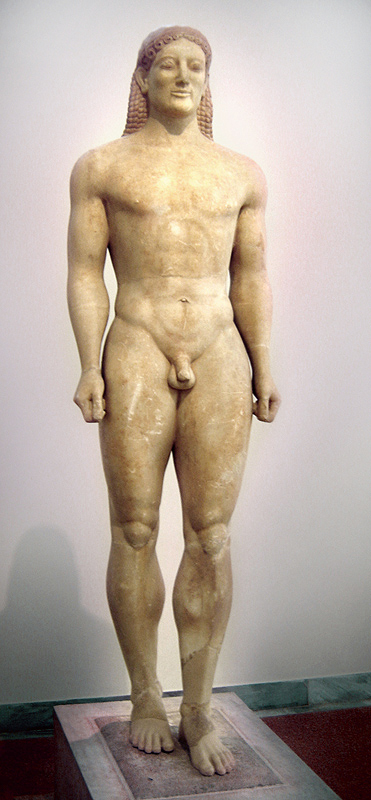
Anavysos Kouros
Anavysos Kouros. Kouros is the modern term given to free-standing Ancient Greek sculptures that depict nude male youths. They first appear in the Archaic period in Greece and are prominent in Attica and Boeotia, with a less frequent presence in many other Ancient Greek territories such as Sicily.
The Ancient Greek word kouros (κοῦρος) refers to "youth, boy, especially of noble rank." When a pubescent was received into the body of grown men, as a grown Kouros, he could enter the initiation fest of the brotherhood (phratry, φρατρία). Apellaios was the month of these rites, and Apollo (Apellon) was the "megistos kouros" (the greatest Kouros). Etymology →
The kouros type appears to have served several functions. It was previously thought that it was used only to represent the god Apollo, as attested by its depiction on a vase painting in the presence of supplicants. Purpose →
The evolution of the kouros type is inevitably linked to that of the overall development of monumental Archaic Greek sculpture. Origin and evolution →
Piraeus Apollo. Kouros is the modern term given to free-standing Ancient Greek sculptures that depict nude male youths. They first appear in the Archaic period in Greece and are prominent in Attica and Boeotia, with a less frequent presence in many other Ancient Greek territories such as Sicily.
The Ancient Greek word kouros (κοῦρος) refers to "youth, boy, especially of noble rank." When a pubescent was received into the body of grown men, as a grown Kouros, he could enter the initiation fest of the brotherhood (phratry, φρατρία). Apellaios was the month of these rites, and Apollo (Apellon) was the "megistos kouros" (the greatest Kouros). Etymology →
The kouros type appears to have served several functions. It was previously thought that it was used only to represent the god Apollo, as attested by its depiction on a vase painting in the presence of supplicants. Purpose →
The evolution of the kouros type is inevitably linked to that of the overall development of monumental Archaic Greek sculpture. Origin and evolution →
Actium 3, Louvre[43]. Kouros is the modern term given to free-standing Ancient Greek sculptures that depict nude male youths. They first appear in the Archaic period in Greece and are prominent in Attica and Boeotia, with a less frequent presence in many other Ancient Greek territories such as Sicily.
The Ancient Greek word kouros (κοῦρος) refers to "youth, boy, especially of noble rank." When a pubescent was received into the body of grown men, as a grown Kouros, he could enter the initiation fest of the brotherhood (phratry, φρατρία). Apellaios was the month of these rites, and Apollo (Apellon) was the "megistos kouros" (the greatest Kouros). Etymology →
The kouros type appears to have served several functions. It was previously thought that it was used only to represent the god Apollo, as attested by its depiction on a vase painting in the presence of supplicants. Purpose →
The evolution of the kouros type is inevitably linked to that of the overall development of monumental Archaic Greek sculpture. Origin and evolution →
Original description: (Ed. ne Alinari) N. ° 22544.PARIS - Musée National du Louvre. Apollon. Sculpture ancienne. - Temple d'Apollon, Actium. · Public domain · Wikimedia Commons
Advancing figure of a man, Saite dynasty, E 5345
Saite sculpture from the Egyptian 26th dynasty, similar in proportion and form to the early kouros type, Louvre[18]. Kouros is the modern term given to free-standing Ancient Greek sculptures that depict nude male youths. They first appear in the Archaic period in Greece and are prominent in Attica and Boeotia, with a less frequent presence in many other Ancient Greek territories such as Sicily.
The Ancient Greek word kouros (κοῦρος) refers to "youth, boy, especially of noble rank." When a pubescent was received into the body of grown men, as a grown Kouros, he could enter the initiation fest of the brotherhood (phratry, φρατρία). Apellaios was the month of these rites, and Apollo (Apellon) was the "megistos kouros" (the greatest Kouros). Etymology →
The kouros type appears to have served several functions. It was previously thought that it was used only to represent the god Apollo, as attested by its depiction on a vase painting in the presence of supplicants. Purpose →
The evolution of the kouros type is inevitably linked to that of the overall development of monumental Archaic Greek sculpture. Origin and evolution →
Agrigento ephebe, Richter (1960).[10]: 182. Kouros is the modern term given to free-standing Ancient Greek sculptures that depict nude male youths. They first appear in the Archaic period in Greece and are prominent in Attica and Boeotia, with a less frequent presence in many other Ancient Greek territories such as Sicily.
The Ancient Greek word kouros (κοῦρος) refers to "youth, boy, especially of noble rank." When a pubescent was received into the body of grown men, as a grown Kouros, he could enter the initiation fest of the brotherhood (phratry, φρατρία). Apellaios was the month of these rites, and Apollo (Apellon) was the "megistos kouros" (the greatest Kouros). Etymology →
The kouros type appears to have served several functions. It was previously thought that it was used only to represent the god Apollo, as attested by its depiction on a vase painting in the presence of supplicants. Purpose →
The evolution of the kouros type is inevitably linked to that of the overall development of monumental Archaic Greek sculpture. Origin and evolution →
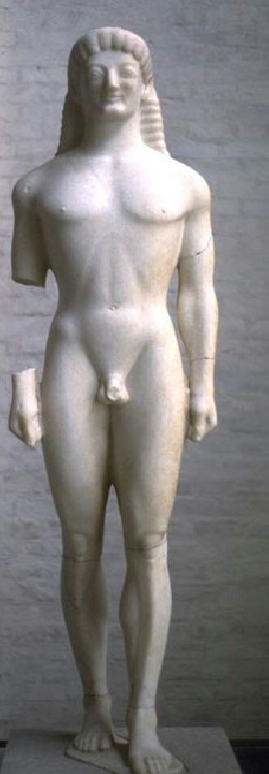
Tenea kouros, Munich 168. Kouros is the modern term given to free-standing Ancient Greek sculptures that depict nude male youths. They first appear in the Archaic period in Greece and are prominent in Attica and Boeotia, with a less frequent presence in many other Ancient Greek territories such as Sicily.
The Ancient Greek word kouros (κοῦρος) refers to "youth, boy, especially of noble rank." When a pubescent was received into the body of grown men, as a grown Kouros, he could enter the initiation fest of the brotherhood (phratry, φρατρία). Apellaios was the month of these rites, and Apollo (Apellon) was the "megistos kouros" (the greatest Kouros). Etymology →
The kouros type appears to have served several functions. It was previously thought that it was used only to represent the god Apollo, as attested by its depiction on a vase painting in the presence of supplicants. Purpose →
The evolution of the kouros type is inevitably linked to that of the overall development of monumental Archaic Greek sculpture. Origin and evolution →
British Museum, London[42]. Kouros is the modern term given to free-standing Ancient Greek sculptures that depict nude male youths. They first appear in the Archaic period in Greece and are prominent in Attica and Boeotia, with a less frequent presence in many other Ancient Greek territories such as Sicily.
The Ancient Greek word kouros (κοῦρος) refers to "youth, boy, especially of noble rank." When a pubescent was received into the body of grown men, as a grown Kouros, he could enter the initiation fest of the brotherhood (phratry, φρατρία). Apellaios was the month of these rites, and Apollo (Apellon) was the "megistos kouros" (the greatest Kouros). Etymology →
The kouros type appears to have served several functions. It was previously thought that it was used only to represent the god Apollo, as attested by its depiction on a vase painting in the presence of supplicants. Purpose →
The evolution of the kouros type is inevitably linked to that of the overall development of monumental Archaic Greek sculpture. Origin and evolution →
Kouros Porte Sacrée Kerameikos Archaeological Museum, Athens (KAMA). Kouros is the modern term given to free-standing Ancient Greek sculptures that depict nude male youths. They first appear in the Archaic period in Greece and are prominent in Attica and Boeotia, with a less frequent presence in many other Ancient Greek territories such as Sicily.
The Ancient Greek word kouros (κοῦρος) refers to "youth, boy, especially of noble rank." When a pubescent was received into the body of grown men, as a grown Kouros, he could enter the initiation fest of the brotherhood (phratry, φρατρία). Apellaios was the month of these rites, and Apollo (Apellon) was the "megistos kouros" (the greatest Kouros). Etymology →
The kouros type appears to have served several functions. It was previously thought that it was used only to represent the god Apollo, as attested by its depiction on a vase painting in the presence of supplicants. Purpose →
The evolution of the kouros type is inevitably linked to that of the overall development of monumental Archaic Greek sculpture. Origin and evolution →
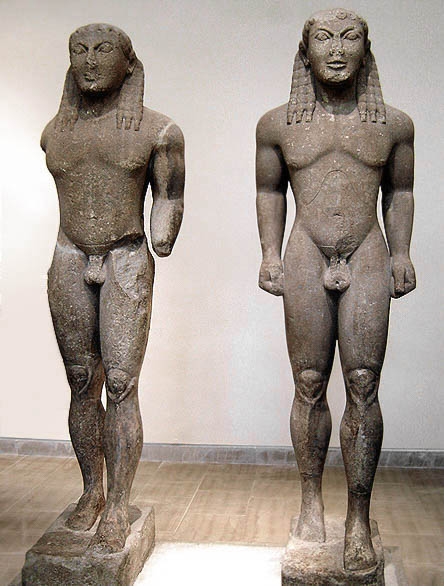
Kleobis and Biton c. 580 BC (Delphi: Archaeological Museum). Kouros is the modern term given to free-standing Ancient Greek sculptures that depict nude male youths. They first appear in the Archaic period in Greece and are prominent in Attica and Boeotia, with a less frequent presence in many other Ancient Greek territories such as Sicily.
The Ancient Greek word kouros (κοῦρος) refers to "youth, boy, especially of noble rank." When a pubescent was received into the body of grown men, as a grown Kouros, he could enter the initiation fest of the brotherhood (phratry, φρατρία). Apellaios was the month of these rites, and Apollo (Apellon) was the "megistos kouros" (the greatest Kouros). Etymology →
The kouros type appears to have served several functions. It was previously thought that it was used only to represent the god Apollo, as attested by its depiction on a vase painting in the presence of supplicants. Purpose →
The evolution of the kouros type is inevitably linked to that of the overall development of monumental Archaic Greek sculpture. Origin and evolution →
Ricardo André Frantz (User:Tetraktys) · CC BY-SA 3.0 · Wikimedia Commons
Text: Wikipedia (CC BY-SA 4.0) ·
Images: Wikimedia Commons,
public domain or Creative Commons (attribution with each work) ·
Part of The Museum at THEODORA

![Kouros[40] from Thera](https://upload.wikimedia.org/wikipedia/commons/3/35/0006MAN-Kouros1.jpg)


![British Museum, London[42]](https://upload.wikimedia.org/wikipedia/commons/a/a5/BM_B474_kouros.jpg)