cave in southwestern France famous for its Paleolithic cave paintings, c. 15000 BCE
Lascaux is a network of caves near the village of Montignac, in the department of Dordogne in southwestern France. Over 600 parietal wall paintings cover the interior walls and ceilings of the cave. The paintings represent primarily large animals, typical local contemporary fauna that correspond with the fossil record of the Upper Paleolithic in the area. They are the combined effort of many generations.
Irish elk (Megaloceros giganteus) with line of dots. Lascaux is a network of caves near the village of Montignac, in the department of Dordogne in southwestern France. Over 600 parietal wall paintings cover the interior walls and ceilings of the cave.
The interpretation of Palaeolithic Art is problematic, as it can be influenced by our own prejudices and beliefs. Some anthropologists and art historians theorize the paintings could be an account of past hunting success, or could represent a mystical ritual in order to improve future hunting endeavors. Interpretation →
On 12 September 1940, the entrance to the Lascaux Cave was discovered on the La Rochefoucauld-Montbel lands by 18-year-old Marcel Ravidat when his dog investigated a hole left by an uprooted tree (Ravidat would embellish the story in later retellings, saying the dog had fallen into the cave). History since rediscovery →
Conservation problems, such as protecting crystal growth and conserving the paintings in the original cave, have made the creation of replicas open to the public more important. Replicas →
Part of Lascaux IV. Lascaux is a network of caves near the village of Montignac, in the department of Dordogne in southwestern France. Over 600 parietal wall paintings cover the interior walls and ceilings of the cave.
The interpretation of Palaeolithic Art is problematic, as it can be influenced by our own prejudices and beliefs. Some anthropologists and art historians theorize the paintings could be an account of past hunting success, or could represent a mystical ritual in order to improve future hunting endeavors. Interpretation →
On 12 September 1940, the entrance to the Lascaux Cave was discovered on the La Rochefoucauld-Montbel lands by 18-year-old Marcel Ravidat when his dog investigated a hole left by an uprooted tree (Ravidat would embellish the story in later retellings, saying the dog had fallen into the cave). History since rediscovery →
Conservation problems, such as protecting crystal growth and conserving the paintings in the original cave, have made the creation of replicas open to the public more important. Replicas →
Cave painting of a dun horse (Equus ferus) at Lascaux. Lascaux is a network of caves near the village of Montignac, in the department of Dordogne in southwestern France. Over 600 parietal wall paintings cover the interior walls and ceilings of the cave.
The interpretation of Palaeolithic Art is problematic, as it can be influenced by our own prejudices and beliefs. Some anthropologists and art historians theorize the paintings could be an account of past hunting success, or could represent a mystical ritual in order to improve future hunting endeavors. Interpretation →
On 12 September 1940, the entrance to the Lascaux Cave was discovered on the La Rochefoucauld-Montbel lands by 18-year-old Marcel Ravidat when his dog investigated a hole left by an uprooted tree (Ravidat would embellish the story in later retellings, saying the dog had fallen into the cave). History since rediscovery →
Conservation problems, such as protecting crystal growth and conserving the paintings in the original cave, have made the creation of replicas open to the public more important. Replicas →
Reproduction of Lascaux artwork in Lascaux II. Lascaux is a network of caves near the village of Montignac, in the department of Dordogne in southwestern France. Over 600 parietal wall paintings cover the interior walls and ceilings of the cave.
The interpretation of Palaeolithic Art is problematic, as it can be influenced by our own prejudices and beliefs. Some anthropologists and art historians theorize the paintings could be an account of past hunting success, or could represent a mystical ritual in order to improve future hunting endeavors. Interpretation →
On 12 September 1940, the entrance to the Lascaux Cave was discovered on the La Rochefoucauld-Montbel lands by 18-year-old Marcel Ravidat when his dog investigated a hole left by an uprooted tree (Ravidat would embellish the story in later retellings, saying the dog had fallen into the cave). History since rediscovery →
Conservation problems, such as protecting crystal growth and conserving the paintings in the original cave, have made the creation of replicas open to the public more important. Replicas →
Modern entrance to the Lascaux cave. Lascaux is a network of caves near the village of Montignac, in the department of Dordogne in southwestern France. Over 600 parietal wall paintings cover the interior walls and ceilings of the cave.
The interpretation of Palaeolithic Art is problematic, as it can be influenced by our own prejudices and beliefs. Some anthropologists and art historians theorize the paintings could be an account of past hunting success, or could represent a mystical ritual in order to improve future hunting endeavors. Interpretation →
On 12 September 1940, the entrance to the Lascaux Cave was discovered on the La Rochefoucauld-Montbel lands by 18-year-old Marcel Ravidat when his dog investigated a hole left by an uprooted tree (Ravidat would embellish the story in later retellings, saying the dog had fallen into the cave). History since rediscovery →
Conservation problems, such as protecting crystal growth and conserving the paintings in the original cave, have made the creation of replicas open to the public more important. Replicas →
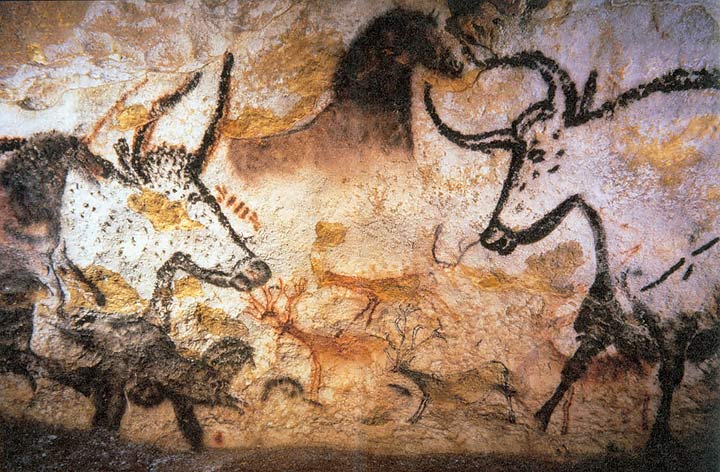
Aurochs, horses and deer painted on a cave. Lascaux is a network of caves near the village of Montignac, in the department of Dordogne in southwestern France. Over 600 parietal wall paintings cover the interior walls and ceilings of the cave.
The interpretation of Palaeolithic Art is problematic, as it can be influenced by our own prejudices and beliefs. Some anthropologists and art historians theorize the paintings could be an account of past hunting success, or could represent a mystical ritual in order to improve future hunting endeavors. Interpretation →
On 12 September 1940, the entrance to the Lascaux Cave was discovered on the La Rochefoucauld-Montbel lands by 18-year-old Marcel Ravidat when his dog investigated a hole left by an uprooted tree (Ravidat would embellish the story in later retellings, saying the dog had fallen into the cave). History since rediscovery →
Conservation problems, such as protecting crystal growth and conserving the paintings in the original cave, have made the creation of replicas open to the public more important. Replicas →
Text: Wikipedia (CC BY-SA 4.0) ·
Images: Wikimedia Commons,
public domain or Creative Commons (attribution with each work) ·
Part of The Museum at THEODORA