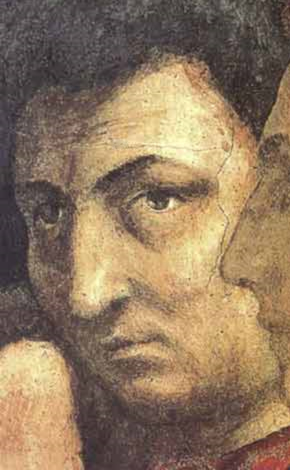
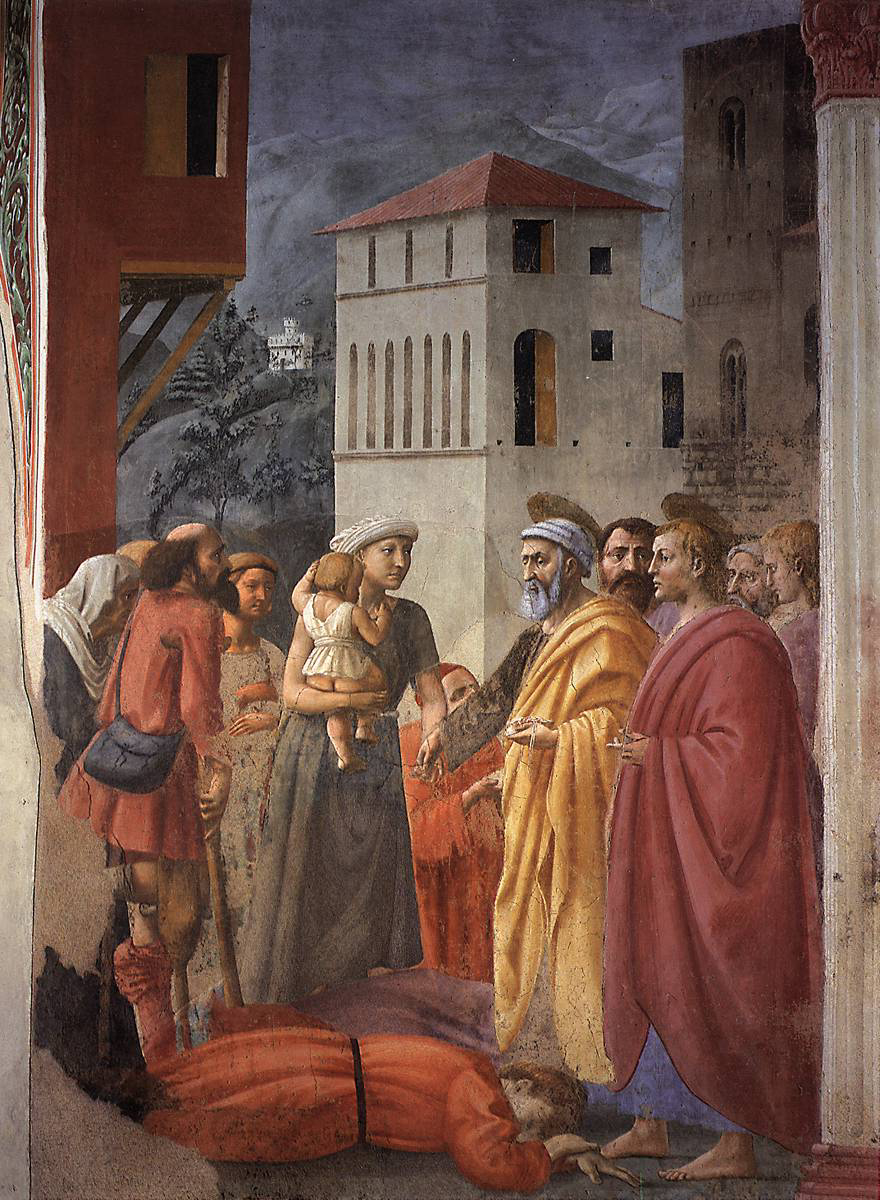
Masaccio, born Tommaso di Ser Giovanni di Simone, was a Florentine artist who is regarded as the first great Italian painter of the Quattrocento period of the Italian Renaissance. According to Vasari, Masaccio was the best painter of his generation because of his skill at imitating nature, recreating lifelike figures and movements as well as a convincing sense of three-dimensionality. He employed nudes and foreshortenings in his figures. This had seldom been done before him.
San Giovenale Triptych is a 1422 painting by Italian Renaissance artist Masaccio, housed in the Masaccio Museum of Sacred Art at Cascia di Reggello, in the Metropolitan City of Florence. The triptych is the first work attributed to Masaccio and the earliest known painting essay using the geometric Renaissance perspective.
Masaccio painted the Triptych when he was 21 years old, probably commissioned by the family of Castellani or by that of Carnesecchi for the small church of San Giovenale, 2 km (1.2 mi) from the Romanic Church at Cascia di Reggello. The presence on the painting of the eponymous saint confirms its original location. History →
The Triptych is a tempera on wooden panels . The central panel is 108 cm × 65 cm (43 in × 26 in) and the two side panels are 88 cm × 44 cm (35 in × 17 in). Description →
The Virgin and Child with Saint Anne, also known as Sant'Anna Metterza, is a painting of c. 1424 to 1425 by the Italian Renaissance painter Masaccio, probably in collaboration with Masolino da Panicale. The painting is in the Galleria degli Uffizi in Florence, Italy, and measures 175 centimetres high and 103 centimetres wide.
The Pisa Altarpiece was a large multi-paneled altarpiece produced by Masaccio for the chapel of Saint Julian in the church of Santa Maria del Carmine in Pisa. The chapel was owned by the notary Giuliano di Colino, who commissioned the work on February 19, 1426 for the sum of 80 florins. Payment for the work was recorded on December 26 of that year.
Eleven surviving panels of the altarpiece, which is the only documented work by Masaccio, are in various museums. Scholars hypothesize the reconstruction of the altarpiece based on a very complete description by Vasari. Surviving panels →
The Crucifixion was placed above the central panel of the altarpiece, underlining the sacrificial (Eucharistic) nature of the central panel. Crucifixion →
Now in the Museo Nazionale di Pisa, the panel of Paul of Tarsus is the only portion of the commissioned work which remains in Pisa. It is usually reconstructed as being one of two flanking panels to the left of the Crucifixion. Saints →
The Pisa Altarpiece was a large multi-paneled altarpiece produced by Masaccio for the chapel of Saint Julian in the church of Santa Maria del Carmine in Pisa. The chapel was owned by the notary Giuliano di Colino, who commissioned the work on February 19, 1426 for the sum of 80 florins. Payment for the work was recorded on December 26 of that year.
Eleven surviving panels of the altarpiece, which is the only documented work by Masaccio, are in various museums. Scholars hypothesize the reconstruction of the altarpiece based on a very complete description by Vasari. Surviving panels →
The Crucifixion was placed above the central panel of the altarpiece, underlining the sacrificial (Eucharistic) nature of the central panel. Crucifixion →
Now in the Museo Nazionale di Pisa, the panel of Paul of Tarsus is the only portion of the commissioned work which remains in Pisa. It is usually reconstructed as being one of two flanking panels to the left of the Crucifixion. Saints →
The Pisa Altarpiece was a large multi-paneled altarpiece produced by Masaccio for the chapel of Saint Julian in the church of Santa Maria del Carmine in Pisa. The chapel was owned by the notary Giuliano di Colino, who commissioned the work on February 19, 1426 for the sum of 80 florins. Payment for the work was recorded on December 26 of that year.
Eleven surviving panels of the altarpiece, which is the only documented work by Masaccio, are in various museums. Scholars hypothesize the reconstruction of the altarpiece based on a very complete description by Vasari. Surviving panels →
The Crucifixion was placed above the central panel of the altarpiece, underlining the sacrificial (Eucharistic) nature of the central panel. Crucifixion →
Now in the Museo Nazionale di Pisa, the panel of Paul of Tarsus is the only portion of the commissioned work which remains in Pisa. It is usually reconstructed as being one of two flanking panels to the left of the Crucifixion. Saints →
This painting, also commonly known as The Berlin Tondo, is a desco da parto, or birth tray, painted by the Italian Renaissance artist Masaccio. Stylistic analysis shows similarities with his San Giovenale Triptych, an early work of the painter from 1422, and the birth tray is dated a short time after it at around 1423. With the frame around it, the tondo has a diameter of 66 cm.
The upper side of the tray shows a scene soon (probably a few days) after the actual birth of a child. It takes place on the ground floor of a well-to-do contemporary house, a palace with white and black stone facings in a very modern style for Tuscan architecture. Top side →
On the reverse side of the tray is a painting of a naked baby boy, a common feature of birthing trays, probably exposed during the pregnancy to encourage the birth of a healthy boy. He is in a meadow playing with a cat (possibly a dog). Reverse →
Text: Wikipedia (CC BY-SA 4.0) ·
Images: Wikimedia Commons,
public domain or Creative Commons (attribution with each work) ·
Part of The Museum at THEODORA