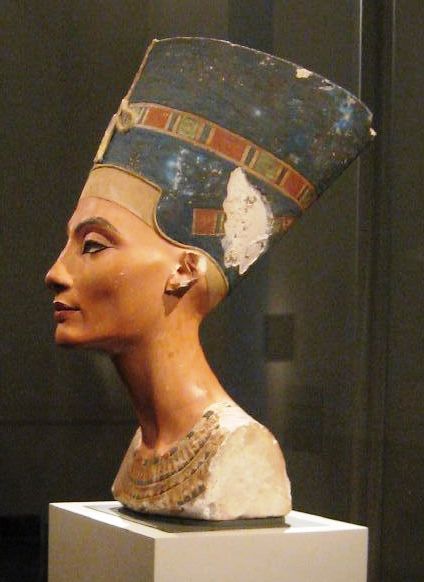
Bust of Queen Nefertiti from the Amarna Period in the Neues Museum, Berlin, c. 1345 BCE
The Nefertiti Bust is a painted stucco-coated limestone bust of Nefertiti, the Great Royal Wife of Egyptian pharaoh Akhenaten. It is on display in the Neues Museum of Berlin.
A "house altar" (c. 1350 BC) depicting Akhenaten, Nefertiti and three of their daughters. Nefertiti is shown wearing a crown similar to that depicted on the bust. The Nefertiti Bust is a painted stucco-coated limestone bust of Nefertiti, the Great Royal Wife of Egyptian pharaoh Akhenaten. It is on display in the Neues Museum of Berlin.
Nefertiti (meaning "the beautiful one has come forth") was the 14th-century BC Great Royal Wife (chief consort) of the Egyptian Pharaoh Akhenaten of the Eighteenth Dynasty of Egypt. Akhenaten initiated a new monotheistic form of worship called Atenism dedicated to the Sun disc Aten. Background →
The bust was found on 6 December 1912 at Amarna by an archaeological team funded by the German Oriental Company (Deutsche Orient-Gesellschaft, DOG), a voluntary association founded by one of the wealthiest men in Prussia, James Simon, who exported more than 20,000 artefacts from Egypt and Iraq. Discovery and removal from Egypt →
The bust is 48 centimetres (19 in) tall and weighs about 20 kilograms (44 lb). It is made of a limestone core covered with painted stucco layers. Description and examinations →
myself (Gerbil from de.wikipedia) · Public domain · Wikimedia Commons
Bust of Nefertiti at the Neues Museum, Berlin
Bust of Nefertiti at the Neues Museum, Berlin. The Nefertiti Bust is a painted stucco-coated limestone bust of Nefertiti, the Great Royal Wife of Egyptian pharaoh Akhenaten. It is on display in the Neues Museum of Berlin.
Nefertiti (meaning "the beautiful one has come forth") was the 14th-century BC Great Royal Wife (chief consort) of the Egyptian Pharaoh Akhenaten of the Eighteenth Dynasty of Egypt. Akhenaten initiated a new monotheistic form of worship called Atenism dedicated to the Sun disc Aten. Background →
The bust was found on 6 December 1912 at Amarna by an archaeological team funded by the German Oriental Company (Deutsche Orient-Gesellschaft, DOG), a voluntary association founded by one of the wealthiest men in Prussia, James Simon, who exported more than 20,000 artefacts from Egypt and Iraq. Discovery and removal from Egypt →
The bust is 48 centimetres (19 in) tall and weighs about 20 kilograms (44 lb). It is made of a limestone core covered with painted stucco layers. Description and examinations →
Original artist unknown, 3-D render made by https://www.myminifactory.com/users/Scan%20The%20World · CC0 · Wikimedia Commons
Nefertiti
Nefertiti (Nofretete in Berlin). The Nefertiti Bust is a painted stucco-coated limestone bust of Nefertiti, the Great Royal Wife of Egyptian pharaoh Akhenaten. It is on display in the Neues Museum of Berlin.
Nefertiti (meaning "the beautiful one has come forth") was the 14th-century BC Great Royal Wife (chief consort) of the Egyptian Pharaoh Akhenaten of the Eighteenth Dynasty of Egypt. Akhenaten initiated a new monotheistic form of worship called Atenism dedicated to the Sun disc Aten. Background →
The bust was found on 6 December 1912 at Amarna by an archaeological team funded by the German Oriental Company (Deutsche Orient-Gesellschaft, DOG), a voluntary association founded by one of the wealthiest men in Prussia, James Simon, who exported more than 20,000 artefacts from Egypt and Iraq. Discovery and removal from Egypt →
The bust is 48 centimetres (19 in) tall and weighs about 20 kilograms (44 lb). It is made of a limestone core covered with painted stucco layers. Description and examinations →
Object in the Ägyptisches Museum Berlin (Egyptian museum, building of the New Museum), Berlin. The Nefertiti Bust is a painted stucco-coated limestone bust of Nefertiti, the Great Royal Wife of Egyptian pharaoh Akhenaten. It is on display in the Neues Museum of Berlin.
Nefertiti (meaning "the beautiful one has come forth") was the 14th-century BC Great Royal Wife (chief consort) of the Egyptian Pharaoh Akhenaten of the Eighteenth Dynasty of Egypt. Akhenaten initiated a new monotheistic form of worship called Atenism dedicated to the Sun disc Aten. Background →
The bust was found on 6 December 1912 at Amarna by an archaeological team funded by the German Oriental Company (Deutsche Orient-Gesellschaft, DOG), a voluntary association founded by one of the wealthiest men in Prussia, James Simon, who exported more than 20,000 artefacts from Egypt and Iraq. Discovery and removal from Egypt →
The bust is 48 centimetres (19 in) tall and weighs about 20 kilograms (44 lb). It is made of a limestone core covered with painted stucco layers. Description and examinations →
Object in the Ägyptisches Museum Berlin (Egyptian museum, building of the New Museum), Berlin. The Nefertiti Bust is a painted stucco-coated limestone bust of Nefertiti, the Great Royal Wife of Egyptian pharaoh Akhenaten. It is on display in the Neues Museum of Berlin.
Nefertiti (meaning "the beautiful one has come forth") was the 14th-century BC Great Royal Wife (chief consort) of the Egyptian Pharaoh Akhenaten of the Eighteenth Dynasty of Egypt. Akhenaten initiated a new monotheistic form of worship called Atenism dedicated to the Sun disc Aten. Background →
The bust was found on 6 December 1912 at Amarna by an archaeological team funded by the German Oriental Company (Deutsche Orient-Gesellschaft, DOG), a voluntary association founded by one of the wealthiest men in Prussia, James Simon, who exported more than 20,000 artefacts from Egypt and Iraq. Discovery and removal from Egypt →
The bust is 48 centimetres (19 in) tall and weighs about 20 kilograms (44 lb). It is made of a limestone core covered with painted stucco layers. Description and examinations →
The famous bust of Nefertiti on display at the Altes Museum. The Nefertiti Bust is a painted stucco-coated limestone bust of Nefertiti, the Great Royal Wife of Egyptian pharaoh Akhenaten. It is on display in the Neues Museum of Berlin.
Nefertiti (meaning "the beautiful one has come forth") was the 14th-century BC Great Royal Wife (chief consort) of the Egyptian Pharaoh Akhenaten of the Eighteenth Dynasty of Egypt. Akhenaten initiated a new monotheistic form of worship called Atenism dedicated to the Sun disc Aten. Background →
The bust was found on 6 December 1912 at Amarna by an archaeological team funded by the German Oriental Company (Deutsche Orient-Gesellschaft, DOG), a voluntary association founded by one of the wealthiest men in Prussia, James Simon, who exported more than 20,000 artefacts from Egypt and Iraq. Discovery and removal from Egypt →
The bust is 48 centimetres (19 in) tall and weighs about 20 kilograms (44 lb). It is made of a limestone core covered with painted stucco layers. Description and examinations →
Neues Museum, Berlin is the present location of the Nefertiti bust. The Nefertiti Bust is a painted stucco-coated limestone bust of Nefertiti, the Great Royal Wife of Egyptian pharaoh Akhenaten. It is on display in the Neues Museum of Berlin.
Nefertiti (meaning "the beautiful one has come forth") was the 14th-century BC Great Royal Wife (chief consort) of the Egyptian Pharaoh Akhenaten of the Eighteenth Dynasty of Egypt. Akhenaten initiated a new monotheistic form of worship called Atenism dedicated to the Sun disc Aten. Background →
The bust was found on 6 December 1912 at Amarna by an archaeological team funded by the German Oriental Company (Deutsche Orient-Gesellschaft, DOG), a voluntary association founded by one of the wealthiest men in Prussia, James Simon, who exported more than 20,000 artefacts from Egypt and Iraq. Discovery and removal from Egypt →
The bust is 48 centimetres (19 in) tall and weighs about 20 kilograms (44 lb). It is made of a limestone core covered with painted stucco layers. Description and examinations →
Picture of the Nefertiti bust in Neues Museum, Berlin. The Nefertiti Bust is a painted stucco-coated limestone bust of Nefertiti, the Great Royal Wife of Egyptian pharaoh Akhenaten. It is on display in the Neues Museum of Berlin.
Nefertiti (meaning "the beautiful one has come forth") was the 14th-century BC Great Royal Wife (chief consort) of the Egyptian Pharaoh Akhenaten of the Eighteenth Dynasty of Egypt. Akhenaten initiated a new monotheistic form of worship called Atenism dedicated to the Sun disc Aten. Background →
The bust was found on 6 December 1912 at Amarna by an archaeological team funded by the German Oriental Company (Deutsche Orient-Gesellschaft, DOG), a voluntary association founded by one of the wealthiest men in Prussia, James Simon, who exported more than 20,000 artefacts from Egypt and Iraq. Discovery and removal from Egypt →
The bust is 48 centimetres (19 in) tall and weighs about 20 kilograms (44 lb). It is made of a limestone core covered with painted stucco layers. Description and examinations →
Photo of the Nefertiti Bust taken in 1912. The Nefertiti Bust is a painted stucco-coated limestone bust of Nefertiti, the Great Royal Wife of Egyptian pharaoh Akhenaten. It is on display in the Neues Museum of Berlin.
Nefertiti (meaning "the beautiful one has come forth") was the 14th-century BC Great Royal Wife (chief consort) of the Egyptian Pharaoh Akhenaten of the Eighteenth Dynasty of Egypt. Akhenaten initiated a new monotheistic form of worship called Atenism dedicated to the Sun disc Aten. Background →
The bust was found on 6 December 1912 at Amarna by an archaeological team funded by the German Oriental Company (Deutsche Orient-Gesellschaft, DOG), a voluntary association founded by one of the wealthiest men in Prussia, James Simon, who exported more than 20,000 artefacts from Egypt and Iraq. Discovery and removal from Egypt →
The bust is 48 centimetres (19 in) tall and weighs about 20 kilograms (44 lb). It is made of a limestone core covered with painted stucco layers. Description and examinations →
queen nefertiti front by Federico Cinquepalmi Own work. The Nefertiti Bust is a painted stucco-coated limestone bust of Nefertiti, the Great Royal Wife of Egyptian pharaoh Akhenaten. It is on display in the Neues Museum of Berlin.
Nefertiti (meaning "the beautiful one has come forth") was the 14th-century BC Great Royal Wife (chief consort) of the Egyptian Pharaoh Akhenaten of the Eighteenth Dynasty of Egypt. Akhenaten initiated a new monotheistic form of worship called Atenism dedicated to the Sun disc Aten. Background →
The bust was found on 6 December 1912 at Amarna by an archaeological team funded by the German Oriental Company (Deutsche Orient-Gesellschaft, DOG), a voluntary association founded by one of the wealthiest men in Prussia, James Simon, who exported more than 20,000 artefacts from Egypt and Iraq. Discovery and removal from Egypt →
The bust is 48 centimetres (19 in) tall and weighs about 20 kilograms (44 lb). It is made of a limestone core covered with painted stucco layers. Description and examinations →
No machine-readable author provided. F. Cinquepalmi assumed (based on copyright claims). · CC BY-SA 3.0 · Wikimedia Commons
Text: Wikipedia (CC BY-SA 4.0) ·
Images: Wikimedia Commons,
public domain or Creative Commons (attribution with each work) ·
Part of The Museum at THEODORA