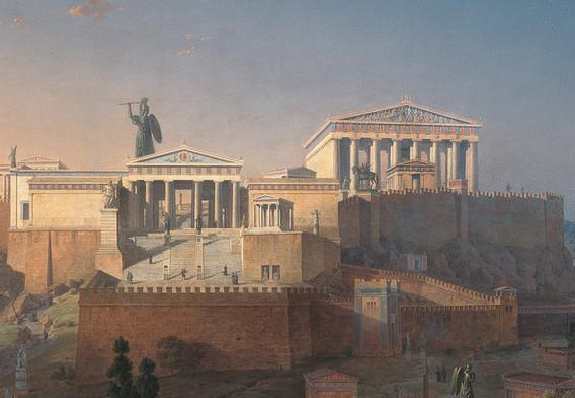
former temple of Athena on the Athenian Acropolis, Greece, 447 to 432 BCE
The Parthenon is a former temple on the Athenian Acropolis, Greece, that was dedicated to the goddess Athena. Its decorative sculptures are considered some of the high points of classical Greek art, and the Parthenon is considered an enduring symbol of ancient Greece, Western civilisation, and democracy.
1868 Lawrence Alma-Tadema - Phidias Showing the Frieze of the Parthenon to his Friends
Phidias Showing the Frieze of the Parthenon to his Friends, 1868 painting by Lawrence Alma-Tadema. The Parthenon is a former temple on the Athenian Acropolis, Greece, that was dedicated to the goddess Athena. Its decorative sculptures are considered some of the high points of classical Greek art, and the Parthenon is considered an enduring symbol of ancient Greece, Western civilisation, and democracy.
The word "Parthenon" comes from the Greek parthénos (παρθένος) 'maiden, girl' as well as 'virgin, unmarried woman'. The Liddell-Scott-Jones Greek-English Lexicon states that it may have referred to the "unmarried women's apartments" in a house, but that in the Parthenon it seems to have been used for a particular room of the temple. Etymology →
Although the Parthenon is architecturally a temple and is usually called so, some scholars have argued that it is not really a temple in the conventional sense of the word. Function →
The first endeavour to build a sanctuary for Athena Parthenos on the site of the present Parthenon was begun shortly after the Battle of Marathon (c. 490 to 488 BC) upon a solid limestone foundation that extended and levelled the southern part of the Acropolis summit. Older Parthenon →
Reconstruction of the Parthenon, on the Acropolis of Athens, Greece. The Parthenon is a former temple on the Athenian Acropolis, Greece, that was dedicated to the goddess Athena. Its decorative sculptures are considered some of the high points of classical Greek art, and the Parthenon is considered an enduring symbol of ancient Greece, Western civilisation, and democracy.
The word "Parthenon" comes from the Greek parthénos (παρθένος) 'maiden, girl' as well as 'virgin, unmarried woman'. The Liddell-Scott-Jones Greek-English Lexicon states that it may have referred to the "unmarried women's apartments" in a house, but that in the Parthenon it seems to have been used for a particular room of the temple. Etymology →
Although the Parthenon is architecturally a temple and is usually called so, some scholars have argued that it is not really a temple in the conventional sense of the word. Function →
The first endeavour to build a sanctuary for Athena Parthenos on the site of the present Parthenon was begun shortly after the Battle of Marathon (c. 490 to 488 BC) upon a solid limestone foundation that extended and levelled the southern part of the Acropolis summit. Older Parthenon →
Part of the east pediment still found on the Parthenon (although part of it, like Dionysus, is a copy). The Parthenon is a former temple on the Athenian Acropolis, Greece, that was dedicated to the goddess Athena. Its decorative sculptures are considered some of the high points of classical Greek art, and the Parthenon is considered an enduring symbol of ancient Greece, Western civilisation, and democracy.
The word "Parthenon" comes from the Greek parthénos (παρθένος) 'maiden, girl' as well as 'virgin, unmarried woman'. The Liddell-Scott-Jones Greek-English Lexicon states that it may have referred to the "unmarried women's apartments" in a house, but that in the Parthenon it seems to have been used for a particular room of the temple. Etymology →
Although the Parthenon is architecturally a temple and is usually called so, some scholars have argued that it is not really a temple in the conventional sense of the word. Function →
The first endeavour to build a sanctuary for Athena Parthenos on the site of the present Parthenon was begun shortly after the Battle of Marathon (c. 490 to 488 BC) upon a solid limestone foundation that extended and levelled the southern part of the Acropolis summit. Older Parthenon →
View of Athens from the Parthenon. The Parthenon is a former temple on the Athenian Acropolis, Greece, that was dedicated to the goddess Athena. Its decorative sculptures are considered some of the high points of classical Greek art, and the Parthenon is considered an enduring symbol of ancient Greece, Western civilisation, and democracy.
The word "Parthenon" comes from the Greek parthénos (παρθένος) 'maiden, girl' as well as 'virgin, unmarried woman'. The Liddell-Scott-Jones Greek-English Lexicon states that it may have referred to the "unmarried women's apartments" in a house, but that in the Parthenon it seems to have been used for a particular room of the temple. Etymology →
Although the Parthenon is architecturally a temple and is usually called so, some scholars have argued that it is not really a temple in the conventional sense of the word. Function →
The first endeavour to build a sanctuary for Athena Parthenos on the site of the present Parthenon was begun shortly after the Battle of Marathon (c. 490 to 488 BC) upon a solid limestone foundation that extended and levelled the southern part of the Acropolis summit. Older Parthenon →
Attica 06-13 Athens 50 View from Philopappos - Acropolis Hill
The Parthenon's position on the Acropolis dominates the city skyline of Athens. The Parthenon is a former temple on the Athenian Acropolis, Greece, that was dedicated to the goddess Athena. Its decorative sculptures are considered some of the high points of classical Greek art, and the Parthenon is considered an enduring symbol of ancient Greece, Western civilisation, and democracy.
The word "Parthenon" comes from the Greek parthénos (παρθένος) 'maiden, girl' as well as 'virgin, unmarried woman'. The Liddell-Scott-Jones Greek-English Lexicon states that it may have referred to the "unmarried women's apartments" in a house, but that in the Parthenon it seems to have been used for a particular room of the temple. Etymology →
Although the Parthenon is architecturally a temple and is usually called so, some scholars have argued that it is not really a temple in the conventional sense of the word. Function →
The first endeavour to build a sanctuary for Athena Parthenos on the site of the present Parthenon was begun shortly after the Battle of Marathon (c. 490 to 488 BC) upon a solid limestone foundation that extended and levelled the southern part of the Acropolis summit. Older Parthenon →
Group from the east pediment, British Museum. The Parthenon is a former temple on the Athenian Acropolis, Greece, that was dedicated to the goddess Athena. Its decorative sculptures are considered some of the high points of classical Greek art, and the Parthenon is considered an enduring symbol of ancient Greece, Western civilisation, and democracy.
The word "Parthenon" comes from the Greek parthénos (παρθένος) 'maiden, girl' as well as 'virgin, unmarried woman'. The Liddell-Scott-Jones Greek-English Lexicon states that it may have referred to the "unmarried women's apartments" in a house, but that in the Parthenon it seems to have been used for a particular room of the temple. Etymology →
Although the Parthenon is architecturally a temple and is usually called so, some scholars have argued that it is not really a temple in the conventional sense of the word. Function →
The first endeavour to build a sanctuary for Athena Parthenos on the site of the present Parthenon was begun shortly after the Battle of Marathon (c. 490 to 488 BC) upon a solid limestone foundation that extended and levelled the southern part of the Acropolis summit. Older Parthenon →
The humanist Cyriacus of Ancona, who revealed the existence of the Parthenon after it had fallen into oblivion in the Middle Ages. The Parthenon is a former temple on the Athenian Acropolis, Greece, that was dedicated to the goddess Athena. Its decorative sculptures are considered some of the high points of classical Greek art, and the Parthenon is considered an enduring symbol of ancient Greece, Western civilisation, and democracy.
The word "Parthenon" comes from the Greek parthénos (παρθένος) 'maiden, girl' as well as 'virgin, unmarried woman'. The Liddell-Scott-Jones Greek-English Lexicon states that it may have referred to the "unmarried women's apartments" in a house, but that in the Parthenon it seems to have been used for a particular room of the temple. Etymology →
Although the Parthenon is architecturally a temple and is usually called so, some scholars have argued that it is not really a temple in the conventional sense of the word. Function →
The first endeavour to build a sanctuary for Athena Parthenos on the site of the present Parthenon was begun shortly after the Battle of Marathon (c. 490 to 488 BC) upon a solid limestone foundation that extended and levelled the southern part of the Acropolis summit. Older Parthenon →
The Doric order of the Parthenon. The Parthenon is a former temple on the Athenian Acropolis, Greece, that was dedicated to the goddess Athena. Its decorative sculptures are considered some of the high points of classical Greek art, and the Parthenon is considered an enduring symbol of ancient Greece, Western civilisation, and democracy.
The word "Parthenon" comes from the Greek parthénos (παρθένος) 'maiden, girl' as well as 'virgin, unmarried woman'. The Liddell-Scott-Jones Greek-English Lexicon states that it may have referred to the "unmarried women's apartments" in a house, but that in the Parthenon it seems to have been used for a particular room of the temple. Etymology →
Although the Parthenon is architecturally a temple and is usually called so, some scholars have argued that it is not really a temple in the conventional sense of the word. Function →
The first endeavour to build a sanctuary for Athena Parthenos on the site of the present Parthenon was begun shortly after the Battle of Marathon (c. 490 to 488 BC) upon a solid limestone foundation that extended and levelled the southern part of the Acropolis summit. Older Parthenon →
Flickr - Nic's events - London - 14-15 Dec 2007 - 067
Life-size pediment sculptures from the Parthenon in the British Museum. The Parthenon is a former temple on the Athenian Acropolis, Greece, that was dedicated to the goddess Athena. Its decorative sculptures are considered some of the high points of classical Greek art, and the Parthenon is considered an enduring symbol of ancient Greece, Western civilisation, and democracy.
The word "Parthenon" comes from the Greek parthénos (παρθένος) 'maiden, girl' as well as 'virgin, unmarried woman'. The Liddell-Scott-Jones Greek-English Lexicon states that it may have referred to the "unmarried women's apartments" in a house, but that in the Parthenon it seems to have been used for a particular room of the temple. Etymology →
Although the Parthenon is architecturally a temple and is usually called so, some scholars have argued that it is not really a temple in the conventional sense of the word. Function →
The first endeavour to build a sanctuary for Athena Parthenos on the site of the present Parthenon was begun shortly after the Battle of Marathon (c. 490 to 488 BC) upon a solid limestone foundation that extended and levelled the southern part of the Acropolis summit. Older Parthenon →
The oldest extant drawing of the Parthenon is found in Manuscript Hamilton 254 on folio 85r, a fifteenth-century manuscript preserved in the Berlin State Library. The Parthenon is a former temple on the Athenian Acropolis, Greece, that was dedicated to the goddess Athena. Its decorative sculptures are considered some of the high points of classical Greek art, and the Parthenon is considered an enduring symbol of ancient Greece, Western civilisation, and democracy.
The word "Parthenon" comes from the Greek parthénos (παρθένος) 'maiden, girl' as well as 'virgin, unmarried woman'. The Liddell-Scott-Jones Greek-English Lexicon states that it may have referred to the "unmarried women's apartments" in a house, but that in the Parthenon it seems to have been used for a particular room of the temple. Etymology →
Although the Parthenon is architecturally a temple and is usually called so, some scholars have argued that it is not really a temple in the conventional sense of the word. Function →
The first endeavour to build a sanctuary for Athena Parthenos on the site of the present Parthenon was begun shortly after the Battle of Marathon (c. 490 to 488 BC) upon a solid limestone foundation that extended and levelled the southern part of the Acropolis summit. Older Parthenon →
Text: Wikipedia (CC BY-SA 4.0) ·
Images: Wikimedia Commons,
public domain or Creative Commons (attribution with each work) ·
Part of The Museum at THEODORA