Polykleitos was an ancient Greek sculptor, active in the 5th century BCE. Alongside the Athenian sculptors Pheidias, Myron and Praxiteles, he is considered as one of the most important sculptors of classical antiquity. The 4th century BCE catalogue attributed to Xenocrates, which was Pliny's guide in matters of art, ranked him between Pheidias and Myron. He is particularly known for his lost treatise, the Canon of Polykleitos, which set out his mathematical basis of an idealised male body shape.
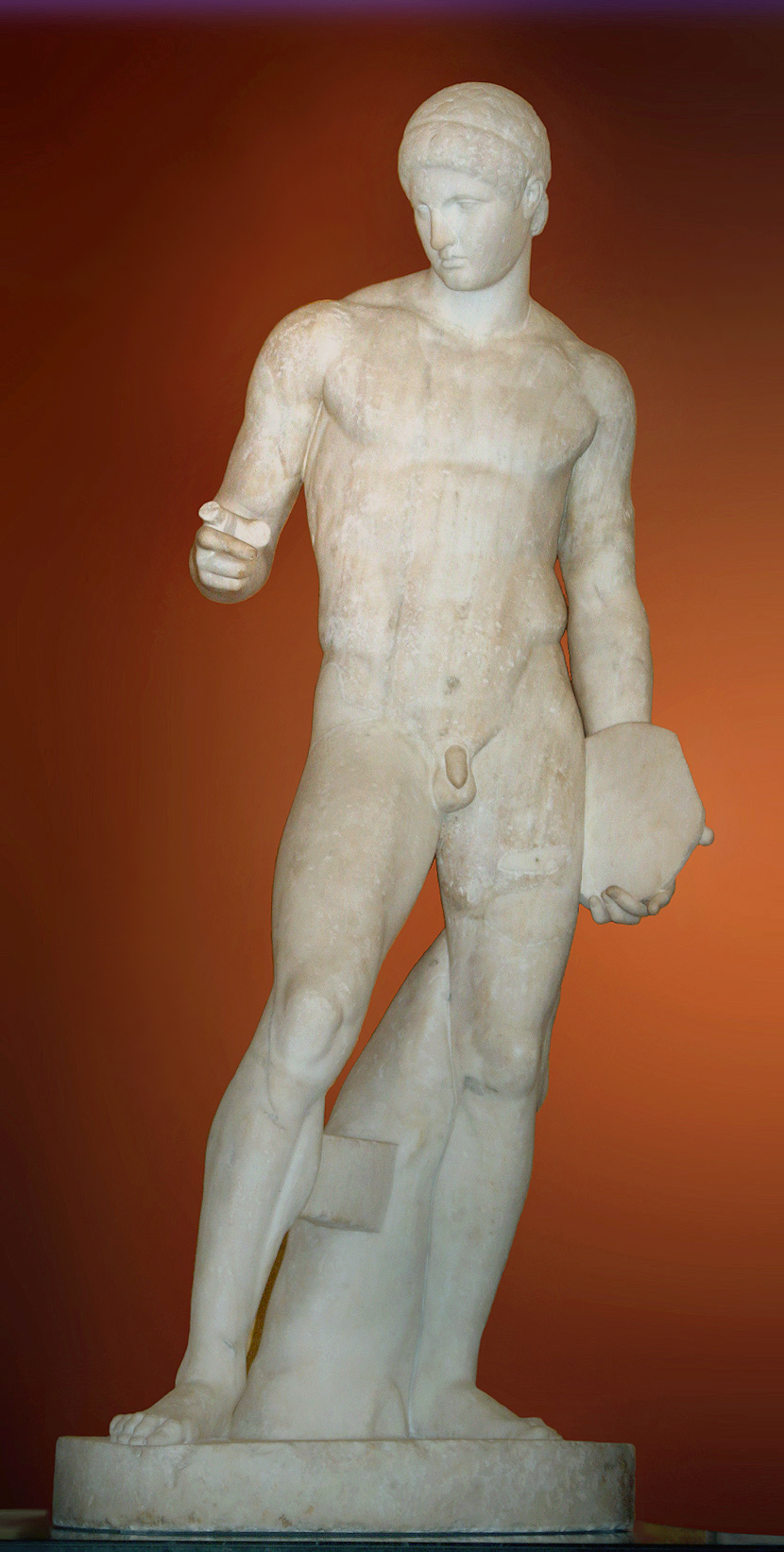
The Discophoros, also spelled Discophorus, was a bronze sculpture by the classical Greek sculptor Polyclitus, which is known today through many Roman marble copies. It is not to be confused with Discobolus of Myron, which shows a discus being thrown, not carried.
The Doryphoros of Polykleitos is one of the best known Greek sculptures of Classical antiquity, depicting a solidly built, muscular, standing warrior, originally bearing a spear balanced on his left shoulder. The lost bronze original of the work would have been cast circa 440 BC, but it is today known only from later marble copies. The work nonetheless forms an important early example of both Classical Greek contrapposto and classical realism; as such, the iconic Doryphoros proved highly influential elsewhere in ancient art.
The original was made out of bronze in about 440 BC but is now lost (along with most other bronze sculptures made by a known Greek artist). Neither the original statue nor the treatise have yet been found; it is widely considered that they have not survived from antiquity. Description →
The Doryphoros was created during the high Classical period. During this time, there was an emphasis put on the ideal man who was shown in heroic nudity. Influence →
The renowned Greek sculptor Polykleitos designed a sculptural work as a demonstration of his written treatise, entitled the Κανών (or 'Canon'), translated as "measure" or "rule", exemplifying what he considered to be the perfectly harmonious and balanced proportions of the human body in the sculpted form. Conception →
So-called Westmacott Athlete, statue of a victorious athlete crowning himself. Marble, Roman copy of the 1st century AD after a Greek original (the statue of Kyniskos?) of ca. 440 BC. Polykleitos was an ancient Greek sculptor, active in the 5th century BCE. Alongside the Athenian sculptors Pheidias, Myron and Praxiteles, he is considered as one of the most important sculptors of classical antiquity.
His Greek name was traditionally Latinized Polycletus, but is also transliterated Polycleitus (Ancient Greek: Πολύκλειτος [polýkleːtos], "much-renowned") and, due to iotacism in the transition from Ancient to Modern Greek, Polyklitos or Polyclitus. He is called Sicyonius (lit. Name →
As noted above, Polykleitos is called "The Sicyonian" by some authors, all writing in Latin, and who modern scholars view as relying on an error of Pliny the Elder in conflating another more minor sculptor from Sikyon, a disciple of Phidias, with Polykleitos of Argos. Early life and training →
Polykleitos's figure of an Amazon for Ephesus was admired, while his colossal gold and ivory statue of Hera which stood in her temple, the Heraion of Argos, was favourably compared with the Olympian Zeus by Pheidias. Works →
On better preserved copies of this figure, the athlete raises his right arm to place a wreath, perhaps a prize for an athletic victory, on his head. The statue may be based on the "Cyniscus" by Polyclitus, a work depicting an Olympic champion boxer of the mid 5th century. Polykleitos was an ancient Greek sculptor, active in the 5th century BCE. Alongside the Athenian sculptors Pheidias, Myron and Praxiteles, he is considered as one of the most important sculptors of classical antiquity.
His Greek name was traditionally Latinized Polycletus, but is also transliterated Polycleitus (Ancient Greek: Πολύκλειτος [polýkleːtos], "much-renowned") and, due to iotacism in the transition from Ancient to Modern Greek, Polyklitos or Polyclitus. He is called Sicyonius (lit. Name →
As noted above, Polykleitos is called "The Sicyonian" by some authors, all writing in Latin, and who modern scholars view as relying on an error of Pliny the Elder in conflating another more minor sculptor from Sikyon, a disciple of Phidias, with Polykleitos of Argos. Early life and training →
Polykleitos's figure of an Amazon for Ephesus was admired, while his colossal gold and ivory statue of Hera which stood in her temple, the Heraion of Argos, was favourably compared with the Olympian Zeus by Pheidias. Works →
Anonymous (Roman artist)Unknown author
Copy after Polykleitos (Greek, active 460-415 BC) · Public domain · Wikimedia Commons
Diadumenos
-430
The Diadumenos, together with the Doryphoros, are two of the most famous figural types of the sculptor Polyclitus, forming a basic pattern of Ancient Greek sculpture that all present a strictly idealized representations of young male athletes in a naturalistic manner.
Both Pliny's Natural History and Lucian's Philopseudes described Roman marbles of a Diadumenos copied from Greek originals in bronze, yet it was not recognized until 1878 that the Roman marble from Vaison-la-Romaine (Roman Vasio) in the British Museum and two others recreate the lost Polyclitan bronze original. Roman copies →
Once the Diadumenos type had been reconnected with Polyclitus in 1878, it was recognised in the modern era by a copy included among the sculptures on the roof of the National Archaeological Museum, Athens when it was completed in 1889. Modern reception →
Apollo of the "Mantua type", marble Roman copy after a 5th-century-BC Greek…
Apollo of the "Mantua type", marble Roman copy after a 5th-century-BC Greek original attributed to Polykleitos, Musée du Louvre. Polykleitos was an ancient Greek sculptor, active in the 5th century BCE. Alongside the Athenian sculptors Pheidias, Myron and Praxiteles, he is considered as one of the most important sculptors of classical antiquity.
His Greek name was traditionally Latinized Polycletus, but is also transliterated Polycleitus (Ancient Greek: Πολύκλειτος [polýkleːtos], "much-renowned") and, due to iotacism in the transition from Ancient to Modern Greek, Polyklitos or Polyclitus. He is called Sicyonius (lit. Name →
As noted above, Polykleitos is called "The Sicyonian" by some authors, all writing in Latin, and who modern scholars view as relying on an error of Pliny the Elder in conflating another more minor sculptor from Sikyon, a disciple of Phidias, with Polykleitos of Argos. Early life and training →
Polykleitos's figure of an Amazon for Ephesus was admired, while his colossal gold and ivory statue of Hera which stood in her temple, the Heraion of Argos, was favourably compared with the Olympian Zeus by Pheidias. Works →
Bronze statue of an athlete from Ephesus cleaning his strigil; 1st century CE…
Bronze statue of an athlete from Ephesus cleaning his strigil; 1st century CE copy of a possible original by Polykleitos. Polykleitos was an ancient Greek sculptor, active in the 5th century BCE. Alongside the Athenian sculptors Pheidias, Myron and Praxiteles, he is considered as one of the most important sculptors of classical antiquity.
His Greek name was traditionally Latinized Polycletus, but is also transliterated Polycleitus (Ancient Greek: Πολύκλειτος [polýkleːtos], "much-renowned") and, due to iotacism in the transition from Ancient to Modern Greek, Polyklitos or Polyclitus. He is called Sicyonius (lit. Name →
As noted above, Polykleitos is called "The Sicyonian" by some authors, all writing in Latin, and who modern scholars view as relying on an error of Pliny the Elder in conflating another more minor sculptor from Sikyon, a disciple of Phidias, with Polykleitos of Argos. Early life and training →
Polykleitos's figure of an Amazon for Ephesus was admired, while his colossal gold and ivory statue of Hera which stood in her temple, the Heraion of Argos, was favourably compared with the Olympian Zeus by Pheidias. Works →
Manfred Werner (Tsui); cropped and edited by Mary Harrsch · CC BY-SA 3.0 · Wikimedia Commons
Diadoumenos-Atenas
A Polykleitan Diadumenos, in a Roman marble copy, National Archaeological Museum of Athens. Polykleitos was an ancient Greek sculptor, active in the 5th century BCE. Alongside the Athenian sculptors Pheidias, Myron and Praxiteles, he is considered as one of the most important sculptors of classical antiquity.
His Greek name was traditionally Latinized Polycletus, but is also transliterated Polycleitus (Ancient Greek: Πολύκλειτος [polýkleːtos], "much-renowned") and, due to iotacism in the transition from Ancient to Modern Greek, Polyklitos or Polyclitus. He is called Sicyonius (lit. Name →
As noted above, Polykleitos is called "The Sicyonian" by some authors, all writing in Latin, and who modern scholars view as relying on an error of Pliny the Elder in conflating another more minor sculptor from Sikyon, a disciple of Phidias, with Polykleitos of Argos. Early life and training →
Polykleitos's figure of an Amazon for Ephesus was admired, while his colossal gold and ivory statue of Hera which stood in her temple, the Heraion of Argos, was favourably compared with the Olympian Zeus by Pheidias. Works →
Ricardo André Frantz (User:Tetraktys) · CC BY-SA 3.0 · Wikimedia Commons
Discophoros BM
The Townley Marbles Discophoros, British Museum. Polykleitos was an ancient Greek sculptor, active in the 5th century BCE. Alongside the Athenian sculptors Pheidias, Myron and Praxiteles, he is considered as one of the most important sculptors of classical antiquity.
His Greek name was traditionally Latinized Polycletus, but is also transliterated Polycleitus (Ancient Greek: Πολύκλειτος [polýkleːtos], "much-renowned") and, due to iotacism in the transition from Ancient to Modern Greek, Polyklitos or Polyclitus. He is called Sicyonius (lit. Name →
As noted above, Polykleitos is called "The Sicyonian" by some authors, all writing in Latin, and who modern scholars view as relying on an error of Pliny the Elder in conflating another more minor sculptor from Sikyon, a disciple of Phidias, with Polykleitos of Argos. Early life and training →
Polykleitos's figure of an Amazon for Ephesus was admired, while his colossal gold and ivory statue of Hera which stood in her temple, the Heraion of Argos, was favourably compared with the Olympian Zeus by Pheidias. Works →
Ricardo André Frantz (User:Tetraktys) · CC BY-SA 3.0 · Wikimedia Commons
Doryphoros MIA 866
Doryphoros, Minneapolis Institute of Art. Polykleitos was an ancient Greek sculptor, active in the 5th century BCE. Alongside the Athenian sculptors Pheidias, Myron and Praxiteles, he is considered as one of the most important sculptors of classical antiquity.
His Greek name was traditionally Latinized Polycletus, but is also transliterated Polycleitus (Ancient Greek: Πολύκλειτος [polýkleːtos], "much-renowned") and, due to iotacism in the transition from Ancient to Modern Greek, Polyklitos or Polyclitus. He is called Sicyonius (lit. Name →
As noted above, Polykleitos is called "The Sicyonian" by some authors, all writing in Latin, and who modern scholars view as relying on an error of Pliny the Elder in conflating another more minor sculptor from Sikyon, a disciple of Phidias, with Polykleitos of Argos. Early life and training →
Polykleitos's figure of an Amazon for Ephesus was admired, while his colossal gold and ivory statue of Hera which stood in her temple, the Heraion of Argos, was favourably compared with the Olympian Zeus by Pheidias. Works →
Text: Wikipedia (CC BY-SA 4.0) ·
Images: Wikimedia Commons,
public domain or Creative Commons (attribution with each work) ·
Part of The Museum at THEODORA