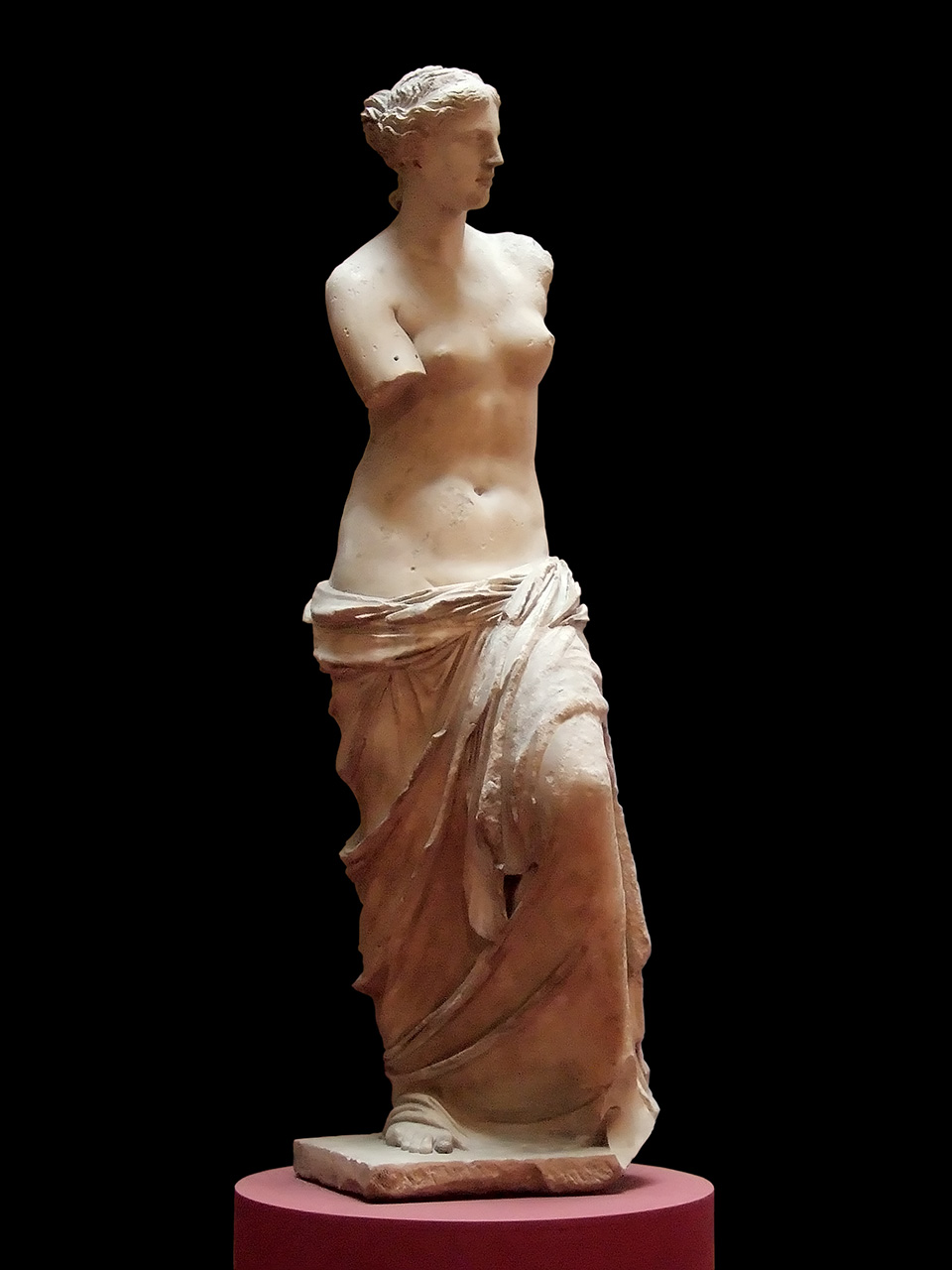
ancient Greek marble statue of a woman, 150 to 125 BCE
The Venus de Milo or Aphrodite of Melos is an ancient Greek marble sculpture that was created during the Hellenistic period. Its exact dating is uncertain, but the modern consensus places it in the 2nd century BC, perhaps between 160 and 110 BC. It was discovered in 1820 on the island of Milos, Greece, and has been displayed at the Louvre Museum since 1821. Since the statue's discovery, it has become one of the most famous works of ancient Greek sculpture in the world.
Aphrodite of Milos (Venus de Milo) at the Louvre. The Venus de Milo or Aphrodite of Melos is an ancient Greek marble sculpture that was created during the Hellenistic period. Its exact dating is uncertain, but the modern consensus places it in the 2nd century BC, perhaps between 160 and 110 BC.
No ancient source can be securely identified as discussing the Venus de Milo, and there are neither enough surviving ancient statues, nor enough evidence about how ancient Greeks judged artistic quality, to judge how the sculpture would have been received in the ancient world. Reception →
The Venus de Milo is an over 2 metres (6 ft 7 in) tall Parian marble statue of a Greek goddess, most likely Aphrodite, depicted with a bare torso and drapery over the lower half of her body. The figure stands with her weight on her right leg, and the left leg raised; her head is turned to the left. Description →
The Venus de Milo was discovered on 8 April 1820 by a Greek farmer on the island of Milos, then still part of the Ottoman Empire. Olivier Voutier, a French sailor interested in archaeology, witnessed the discovery and encouraged the farmer to continue digging. Discovery →
Sketch of the Venus and two herms found with it by Olivier Voutier, made shortly after the discovery. The Venus de Milo or Aphrodite of Melos is an ancient Greek marble sculpture that was created during the Hellenistic period. Its exact dating is uncertain, but the modern consensus places it in the 2nd century BC, perhaps between 160 and 110 BC.
No ancient source can be securely identified as discussing the Venus de Milo, and there are neither enough surviving ancient statues, nor enough evidence about how ancient Greeks judged artistic quality, to judge how the sculpture would have been received in the ancient world. Reception →
The Venus de Milo is an over 2 metres (6 ft 7 in) tall Parian marble statue of a Greek goddess, most likely Aphrodite, depicted with a bare torso and drapery over the lower half of her body. The figure stands with her weight on her right leg, and the left leg raised; her head is turned to the left. Description →
The Venus de Milo was discovered on 8 April 1820 by a Greek farmer on the island of Milos, then still part of the Ottoman Empire. Olivier Voutier, a French sailor interested in archaeology, witnessed the discovery and encouraged the farmer to continue digging. Discovery →
Front views of the Venus de Milo. The Venus de Milo or Aphrodite of Melos is an ancient Greek marble sculpture that was created during the Hellenistic period. Its exact dating is uncertain, but the modern consensus places it in the 2nd century BC, perhaps between 160 and 110 BC.
No ancient source can be securely identified as discussing the Venus de Milo, and there are neither enough surviving ancient statues, nor enough evidence about how ancient Greeks judged artistic quality, to judge how the sculpture would have been received in the ancient world. Reception →
The Venus de Milo is an over 2 metres (6 ft 7 in) tall Parian marble statue of a Greek goddess, most likely Aphrodite, depicted with a bare torso and drapery over the lower half of her body. The figure stands with her weight on her right leg, and the left leg raised; her head is turned to the left. Description →
The Venus de Milo was discovered on 8 April 1820 by a Greek farmer on the island of Milos, then still part of the Ottoman Empire. Olivier Voutier, a French sailor interested in archaeology, witnessed the discovery and encouraged the farmer to continue digging. Discovery →
A photograph of a proposed restoration of the Venus of Milo (Venus de Milo) by Adolf Furtwängler incorporating the arm fragments found with the statue at the time of its discovery. The Venus de Milo or Aphrodite of Melos is an ancient Greek marble sculpture that was created during the Hellenistic period. Its exact dating is uncertain, but the modern consensus places it in the 2nd century BC, perhaps between 160 and 110 BC.
No ancient source can be securely identified as discussing the Venus de Milo, and there are neither enough surviving ancient statues, nor enough evidence about how ancient Greeks judged artistic quality, to judge how the sculpture would have been received in the ancient world. Reception →
The Venus de Milo is an over 2 metres (6 ft 7 in) tall Parian marble statue of a Greek goddess, most likely Aphrodite, depicted with a bare torso and drapery over the lower half of her body. The figure stands with her weight on her right leg, and the left leg raised; her head is turned to the left. Description →
The Venus de Milo was discovered on 8 April 1820 by a Greek farmer on the island of Milos, then still part of the Ottoman Empire. Olivier Voutier, a French sailor interested in archaeology, witnessed the discovery and encouraged the farmer to continue digging. Discovery →
Joan Crawford posing as the Venus de Milo for a 1928 article in Photoplay. The Venus de Milo or Aphrodite of Melos is an ancient Greek marble sculpture that was created during the Hellenistic period. Its exact dating is uncertain, but the modern consensus places it in the 2nd century BC, perhaps between 160 and 110 BC.
No ancient source can be securely identified as discussing the Venus de Milo, and there are neither enough surviving ancient statues, nor enough evidence about how ancient Greeks judged artistic quality, to judge how the sculpture would have been received in the ancient world. Reception →
The Venus de Milo is an over 2 metres (6 ft 7 in) tall Parian marble statue of a Greek goddess, most likely Aphrodite, depicted with a bare torso and drapery over the lower half of her body. The figure stands with her weight on her right leg, and the left leg raised; her head is turned to the left. Description →
The Venus de Milo was discovered on 8 April 1820 by a Greek farmer on the island of Milos, then still part of the Ottoman Empire. Olivier Voutier, a French sailor interested in archaeology, witnessed the discovery and encouraged the farmer to continue digging. Discovery →
The Venus de Milo on display in the Louvre, c. 1824 to 1830, attributed to Joseph Warlencourt. The Venus de Milo or Aphrodite of Melos is an ancient Greek marble sculpture that was created during the Hellenistic period. Its exact dating is uncertain, but the modern consensus places it in the 2nd century BC, perhaps between 160 and 110 BC.
No ancient source can be securely identified as discussing the Venus de Milo, and there are neither enough surviving ancient statues, nor enough evidence about how ancient Greeks judged artistic quality, to judge how the sculpture would have been received in the ancient world. Reception →
The Venus de Milo is an over 2 metres (6 ft 7 in) tall Parian marble statue of a Greek goddess, most likely Aphrodite, depicted with a bare torso and drapery over the lower half of her body. The figure stands with her weight on her right leg, and the left leg raised; her head is turned to the left. Description →
The Venus de Milo was discovered on 8 April 1820 by a Greek farmer on the island of Milos, then still part of the Ottoman Empire. Olivier Voutier, a French sailor interested in archaeology, witnessed the discovery and encouraged the farmer to continue digging. Discovery →
Attributed to Joseph Warlencourt · Public domain · Wikimedia Commons
MG-Paris-Aphrodite of Milos
Front view. The Venus de Milo or Aphrodite of Melos is an ancient Greek marble sculpture that was created during the Hellenistic period. Its exact dating is uncertain, but the modern consensus places it in the 2nd century BC, perhaps between 160 and 110 BC.
No ancient source can be securely identified as discussing the Venus de Milo, and there are neither enough surviving ancient statues, nor enough evidence about how ancient Greeks judged artistic quality, to judge how the sculpture would have been received in the ancient world. Reception →
The Venus de Milo is an over 2 metres (6 ft 7 in) tall Parian marble statue of a Greek goddess, most likely Aphrodite, depicted with a bare torso and drapery over the lower half of her body. The figure stands with her weight on her right leg, and the left leg raised; her head is turned to the left. Description →
The Venus de Milo was discovered on 8 April 1820 by a Greek farmer on the island of Milos, then still part of the Ottoman Empire. Olivier Voutier, a French sailor interested in archaeology, witnessed the discovery and encouraged the farmer to continue digging. Discovery →
Venus de Milo drawn by Auguste Debay. The inscribed plinth, if originally part of the Venus, identifies the sculptor as [---]andros of Antioch on the Maeander and supports a date for the work in the Hellenistic period. The Venus de Milo or Aphrodite of Melos is an ancient Greek marble sculpture that was created during the Hellenistic period. Its exact dating is uncertain, but the modern consensus places it in the 2nd century BC, perhaps between 160 and 110 BC.
No ancient source can be securely identified as discussing the Venus de Milo, and there are neither enough surviving ancient statues, nor enough evidence about how ancient Greeks judged artistic quality, to judge how the sculpture would have been received in the ancient world. Reception →
The Venus de Milo is an over 2 metres (6 ft 7 in) tall Parian marble statue of a Greek goddess, most likely Aphrodite, depicted with a bare torso and drapery over the lower half of her body. The figure stands with her weight on her right leg, and the left leg raised; her head is turned to the left. Description →
The Venus de Milo was discovered on 8 April 1820 by a Greek farmer on the island of Milos, then still part of the Ottoman Empire. Olivier Voutier, a French sailor interested in archaeology, witnessed the discovery and encouraged the farmer to continue digging. Discovery →
The Venus de Milo or Aphrodite of Melos is an ancient Greek marble sculpture that was created during the Hellenistic period. Its exact dating is uncertain, but the modern consensus places it in the 2nd century BC, perhaps between 160 and 110 BC. It was discovered in 1820 on the island of Milos, Greece, and has been displayed at the Louvre Museum since 1821.
No ancient source can be securely identified as discussing the Venus de Milo, and there are neither enough surviving ancient statues, nor enough evidence about how ancient Greeks judged artistic quality, to judge how the sculpture would have been received in the ancient world. Reception →
The Venus de Milo is an over 2 metres (6 ft 7 in) tall Parian marble statue of a Greek goddess, most likely Aphrodite, depicted with a bare torso and drapery over the lower half of her body. The figure stands with her weight on her right leg, and the left leg raised; her head is turned to the left. Description →
The Venus de Milo was discovered on 8 April 1820 by a Greek farmer on the island of Milos, then still part of the Ottoman Empire. Olivier Voutier, a French sailor interested in archaeology, witnessed the discovery and encouraged the farmer to continue digging. Discovery →
The Connoisseur (c. 1860 to c. 1865), by Honoré Daumier
The Connoisseur (c. 1860 to c. 1865), by Honoré Daumier. The Venus de Milo or Aphrodite of Melos is an ancient Greek marble sculpture that was created during the Hellenistic period. Its exact dating is uncertain, but the modern consensus places it in the 2nd century BC, perhaps between 160 and 110 BC.
No ancient source can be securely identified as discussing the Venus de Milo, and there are neither enough surviving ancient statues, nor enough evidence about how ancient Greeks judged artistic quality, to judge how the sculpture would have been received in the ancient world. Reception →
The Venus de Milo is an over 2 metres (6 ft 7 in) tall Parian marble statue of a Greek goddess, most likely Aphrodite, depicted with a bare torso and drapery over the lower half of her body. The figure stands with her weight on her right leg, and the left leg raised; her head is turned to the left. Description →
The Venus de Milo was discovered on 8 April 1820 by a Greek farmer on the island of Milos, then still part of the Ottoman Empire. Olivier Voutier, a French sailor interested in archaeology, witnessed the discovery and encouraged the farmer to continue digging. Discovery →
Text: Wikipedia (CC BY-SA 4.0) ·
Images: Wikimedia Commons,
public domain or Creative Commons (attribution with each work) ·
Part of The Museum at THEODORA