We all know Basquiat: the kid from Brooklyn who started with graffiti on the streets of Manhattan, became one of the artists who defined 1980s New York, and joined the dubious club of gifted people whose lives ended at 27.
The crowns, the skulls, the crossed-out words, and the feeling that every painting was born in a stormy, one-time burst of creativity are the style identified with Basquiat. Or at least that is what people think.
The exhibition at Princeton shows exactly the opposite.
At its center are 11 paintings from 1984, The Blue Ribbon Paintings, shown together for the first time in more than thirty years. The name comes from Pabst Blue Ribbon beer, whose logo and bottle cap appear in every one of the works.
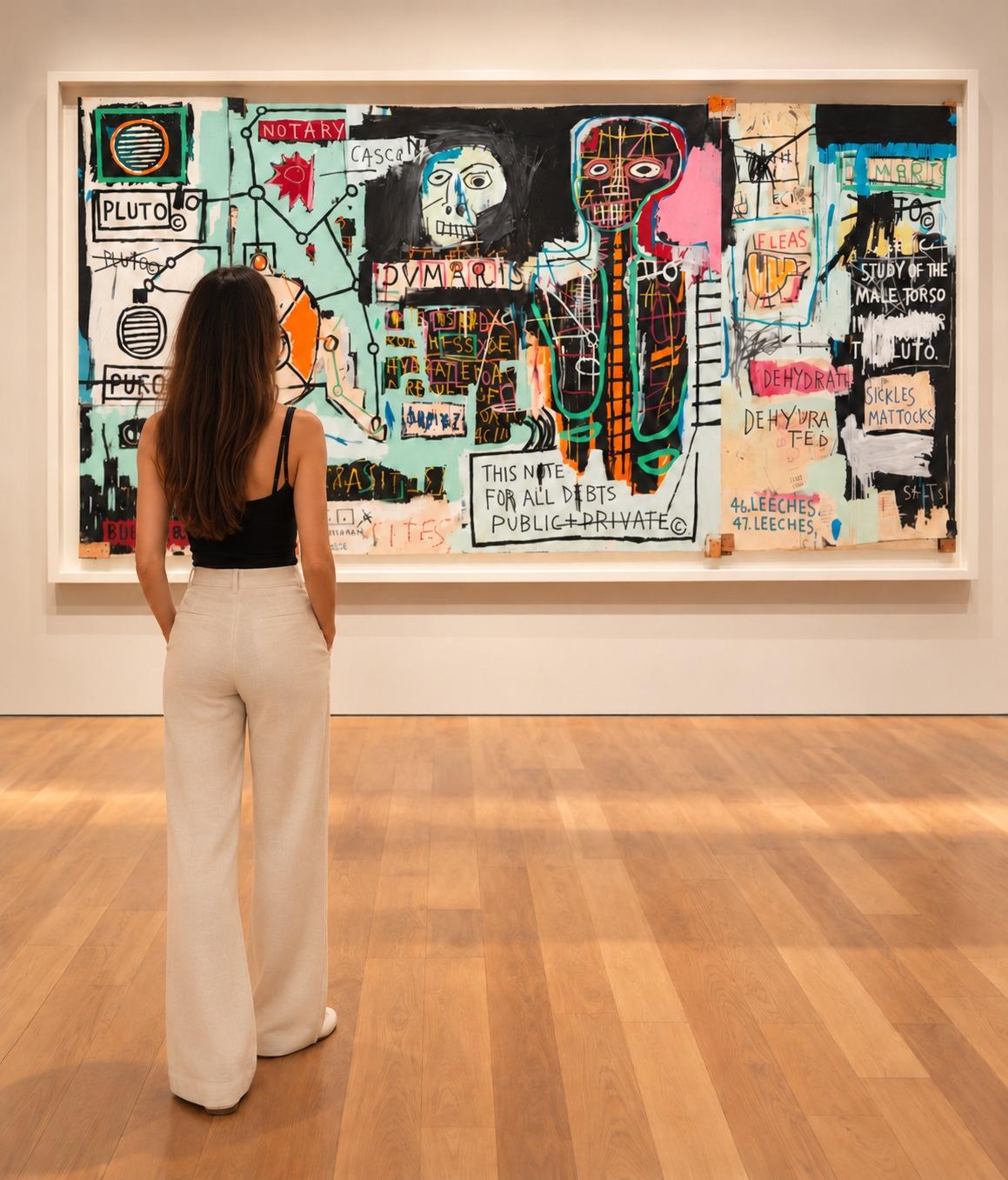
The works are packed with layers of images: anatomical diagrams, film logos, crowned figures, fragments of text and symbols that return again and again. Here Basquiat worked with acrylic, oilstick and silkscreen, so some of the images are not painted by hand but printed onto the canvas. It is worth moving from painting to painting and looking for the elements that repeat, each time in a different color, a different context and beside different words. Suddenly the spontaneous genius turns out to be someone who worked with a complex, calculated method.
One of the interesting things the exhibition highlights is that Basquiat was working with print and reproduction long before he met Andy Warhol. Already in the late 1970s he made postcards using a photocopier. Later, when he came to Los Angeles ahead of a show with Larry Gagosian, he met the printer Fred Hoffman and went deeper into silkscreen. He photographed his own drawings, cut them up, rearranged them and built complex printing screens from them. He did not just paint an image: he returned to it, copied it, changed it, erased it and built something new from it. And that is also what sets him apart from Warhol. Warhol took images from the world outside: Marilyn Monroe, soup cans, dollar bills. Basquiat took, again and again, from his own visual and personal world.
The exhibition presents Basquiat not only as an artist who defined the 1980s, but also as a conceptual artist who dealt with questions of identity, visibility, ownership and originality, especially at a time when the art world was becoming more and more commercial. Nearly all of his known print projects are on view here, alongside works that show his connections to artists such as Robert Rauschenberg and to pioneering Black printmakers, among them Bob Blackburn. In this way a broader tradition is revealed too, of experiment, creativity and the exchange of knowledge between generations of Black artists in printmaking and reproduction.
In my eyes, this is exactly the kind of exhibition that brings curiosity back to an artist we feel we have already come to know. It reminds us that beneath the chaos, the colors and the words lies a very sophisticated system of repetition, editing, copying, erasing and rebuilding.
📍Princeton University Art Museum
Through January 31, 2027
Admission is free
Guided tours on most Saturdays through the end of December, at 11:00 (meet at the information desk)
Enjoy 🤍