The swimming pool is one of the most loaded images in Israeli art. Inside the blue rectangle of water, ideology and fantasy meet, the collective and the individual, body and memory, abundance and escapism.
Over the years its meaning has shifted along with Israeli society: from the pioneering ethos of making the desert bloom, of shared life and the collective, toward more private and intimate spaces, of the body, class, psyche, and fantasy.
Through the work of five artists, we will try to look at what hides beneath the surface of the water.
1. Tanja Lažetić | "Six Swimming Pools Behind Broken Glass," 2014
Lažetić's starting point is actually in Los Angeles.
In 1968 the American artist Ed Ruscha published Nine Swimming Pools and a Broken Glass, an artist's book that became a canon of conceptual art. Ruscha documented private, empty pools around Los Angeles: quiet blue surfaces, ringed by lawns, umbrellas, and diving boards, symbols of a culture of leisure and luxury emptied of any human presence.
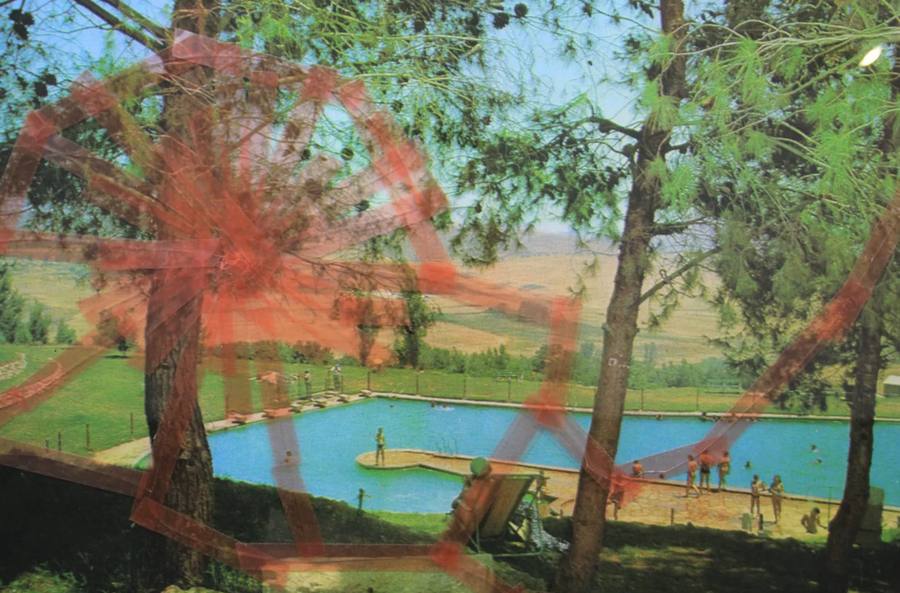
Almost five decades later, Lažetić returns to that work through Israeli history. She collects postcards from the 1970s of pools at rest houses and kibbutzim. Unlike Ruscha's private, empty pools, the Israeli ones are full of people: children, women, and families. They are surrounded by lawns, groves, and landscape, an image of collective leisure and of a communal society.
Each pool is seen through a shattered mirror, and so the idyll cracks as well. The pool becomes a marker of ideology and of power relations: between sharing and privilege, between the Histadrut convalescence of the past and today's consumer culture, and between the Israeli collective that was promised and what remains of it.
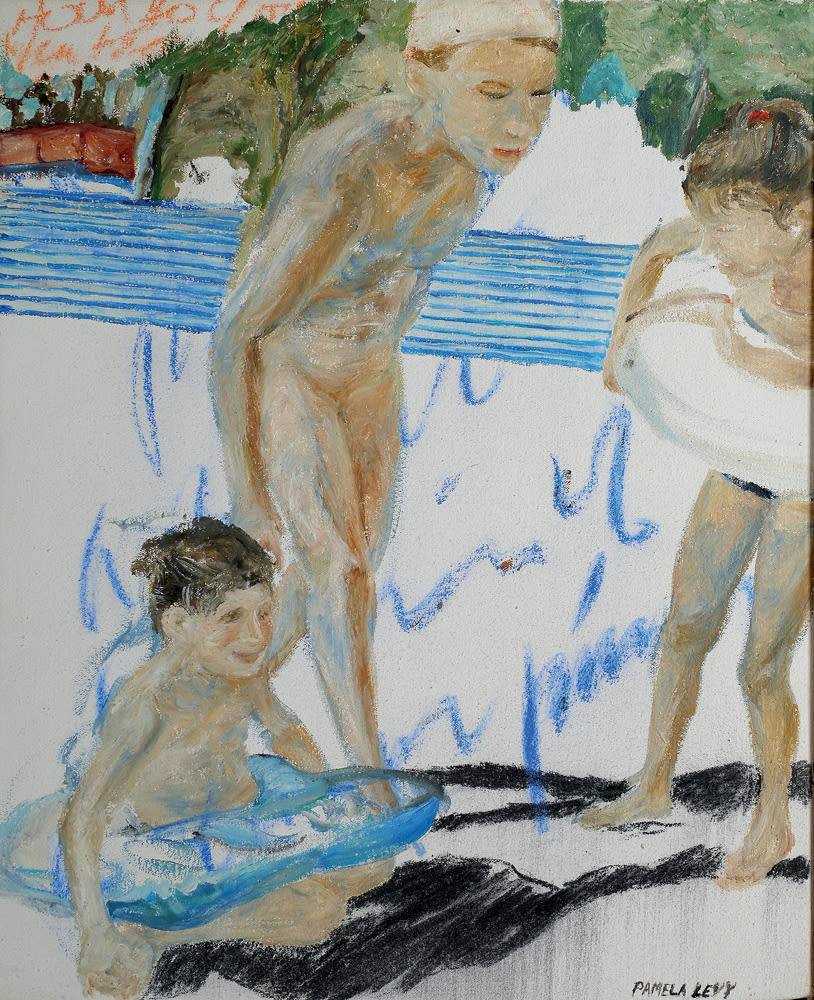
2. Pamela Levy | Pool
Levy (1949-2004), born in the United States, was one of the pioneers of feminist art in Israel. She was ahead of her time and touched on subjects that in the 1980s and 1990s were still taboo: the male gaze on the female body, sexual violence, vulnerability. Even when she paints the sea or a swimming pool, spaces supposedly tied to summer, freedom, and innocence, something is not at ease. Beneath a scene that looks innocent, a quiet danger is always stirring. Children, girls on the verge of adolescence, are crowded densely onto the canvas, exposed not only physically but also to the gaze that watches them. The pool becomes a space where the line between innocence and seduction, between pleasure and danger, and between looking and voyeurism turns especially unsettling.
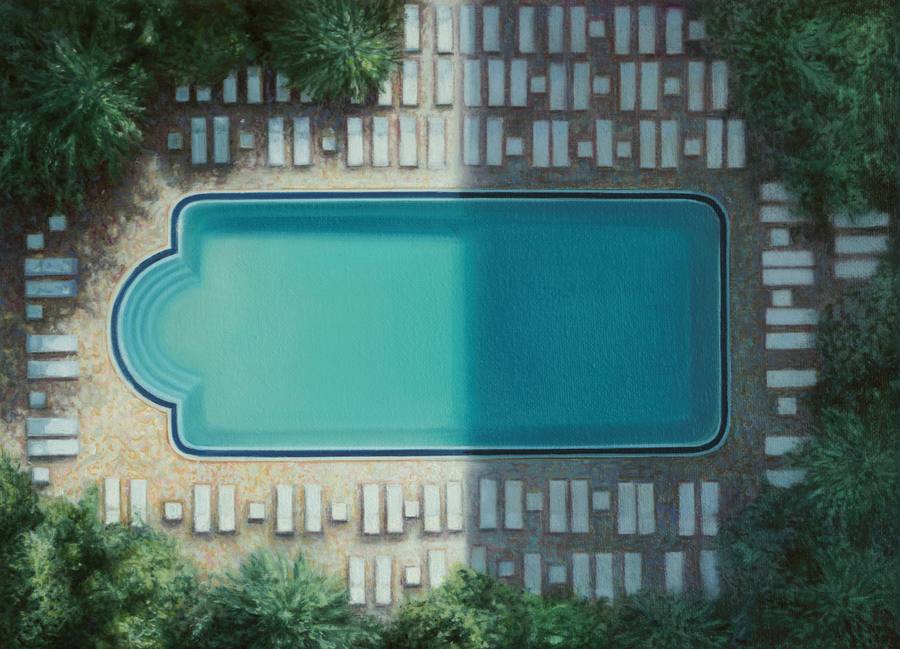
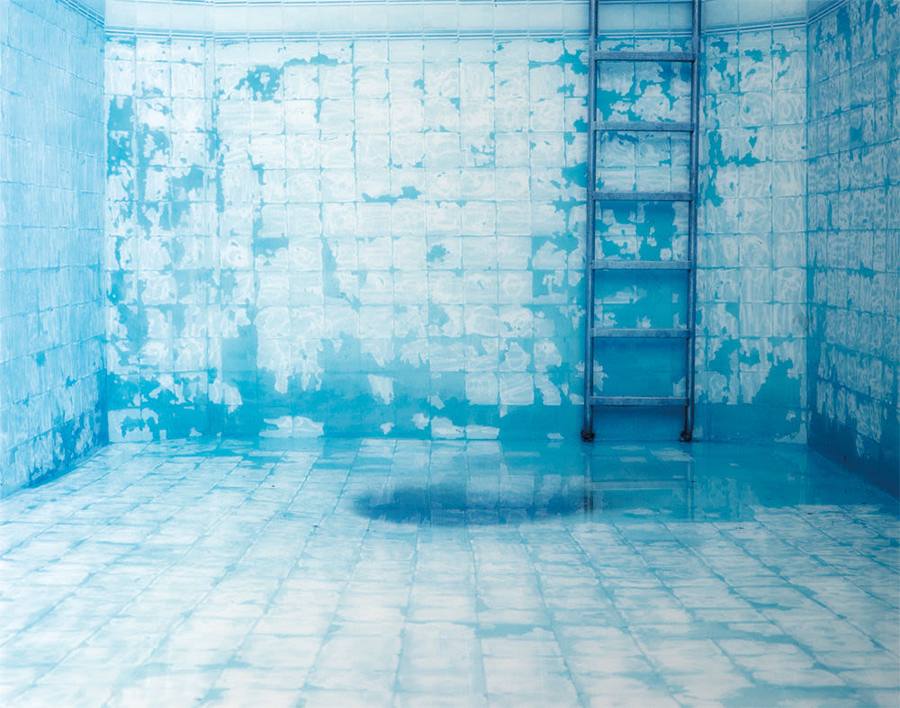
3. Tal Shochat | "Pool," 2003
With Tal Shochat we move into another world: quiet, meticulous, and almost perfect. Shochat's photographs are staged down to the last detail. The lighting is artificial, the composition controlled, and the sharpness almost hyperreal. Her work constantly examines the blurred border between the natural and the artificial, between documentation and fantasy. Her pool is too beautiful, tempting us to step into a world of water, beauty, and calm, and at the same time exposing the artifice behind the fantasy. This is a pool built to look perfect, and that is exactly what makes it slightly disturbing: a beauty so controlled that it no longer feels real.
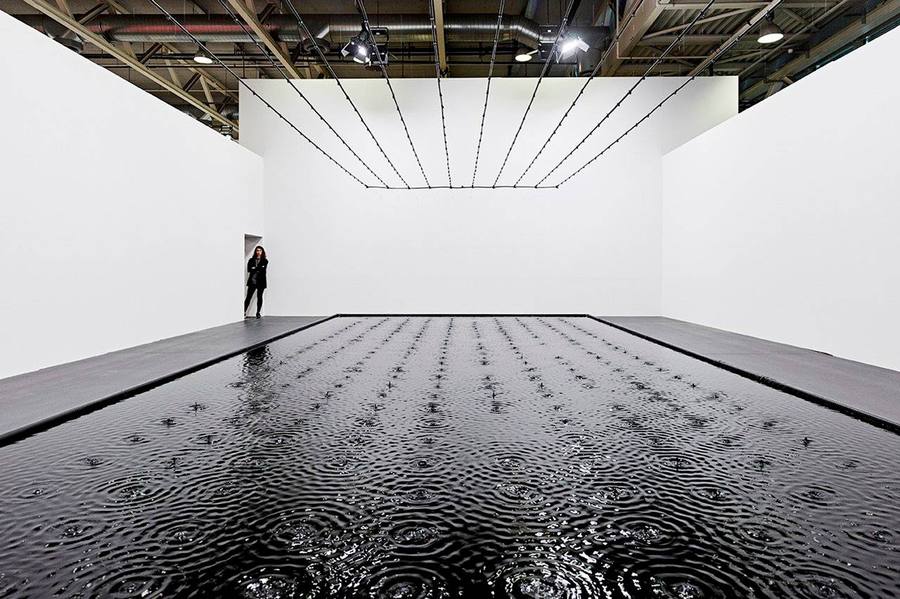
4. Belu-Simion Fainaru | "Rose of Nothingness," Venice Biennale, 2026
With Belu-Simion Fainaru the water changes its meaning once again. In the installation chosen to represent Israel at the 61st Venice Biennale, a black pool collects drops that fall from a system of drippers suspended above it. Here there is no swimming, no body, no vacation. The water becomes a material of time, memory, and mourning. Each drop strikes the surface of the pool, creates a ripple, and is swallowed into it.
The pool, which at the start of our story was a symbol of society, abundance, and leisure, becomes here a quiet, meditative space of absence. This is an image almost entirely opposite to the pool we know as a place of body, sun, and pleasure.
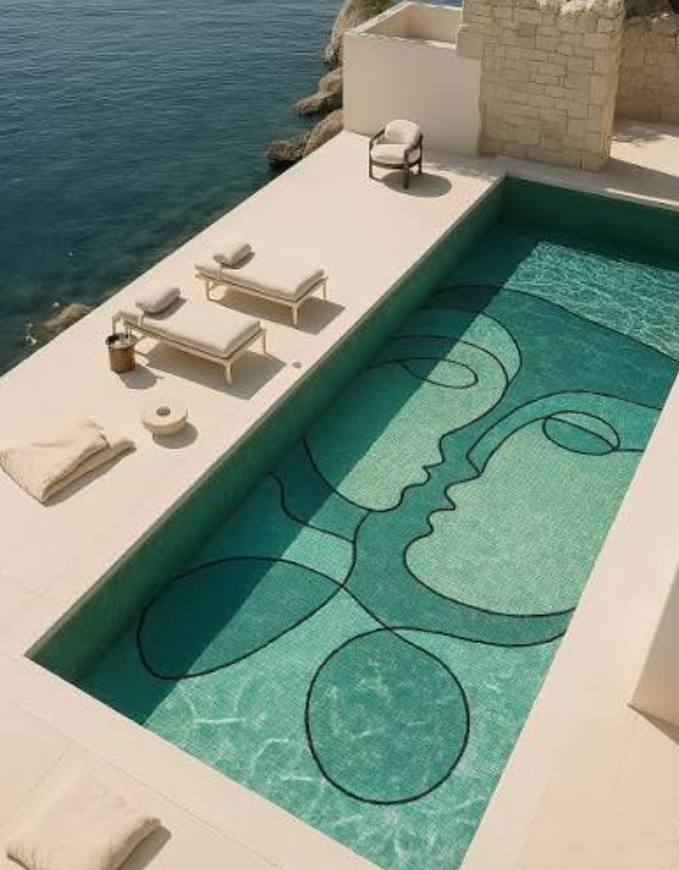
5. Shira Barzilay (Koketit) | Pool Art
Shira Barzilay, known worldwide as "Koketit," closes the circle in a completely different place. Every work of hers begins from a single continuous line, a face or a female body taking shape from a minimalist line that leaves the paper and moves onto the floor of the swimming pool. And when the water moves and the sun breaks across it, the static drawing begins to move, the lines distort with the motion, and the painted body seems for a moment alive and breathing.
For Barzilay the pool is neither critique nor longing. It is a canvas, lightness, beauty, luxury.
After the collective, political, threatening, artificial, and mourning pool, we end with the pool as a space of body, movement, beauty, and pleasure. One rectangle of water tells the whole Israeli story: what was shared, what cracked, and what remained beautiful in spite of everything.